Advertisements
Advertisements
प्रश्न
The primary treatment of waste water involves the removal of ______.
पर्याय
dissolved impurities
stable particles
toxic substances
harmful bacteria
Advertisements
उत्तर
The primary treatment of waste water involves the removal of stable particles.
APPEARS IN
संबंधित प्रश्न
Explain the function of “anaerobic sludge digester” in a sewage treatment plant.
Distinguish between the roles of flocs and anaerobic sludge digesters in sewage treatments.
What are flocs with respect to sewage treatment?
Small part of activated sludge is passed back into primary sedimentation tank.
If the above statement is correct then rewrite as it is and in case it is incorrect then reframe it.
In which of the following microbial digestion of organic wastes of sewage takes place?
Which of the following is TRUE about primary treatment?
Which of the following is/are found in discharge from industrial waste?
Small part of activated sludge is passed back into ______ and major part is pumped into large tanks called ______.
Identify the type of microorganisms involved in floe formation during sewage treatment.
Identify the INCORRECT statement with respect to sewage treatment.
Which of the following process is a part of preliminary treatment of sewage?
Nitrogen fixation by organisms requires conditions that are:
Wastewater treatment generates a large quantity of sludge, which can be treated by ______.
Ganga has recently been declared the national river. Discuss the implication with respect to pollution of this river.
Study the given diagram of the Sewage Treatment Plant (S.T.P.) and answer the question that follows:
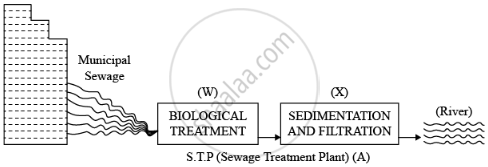
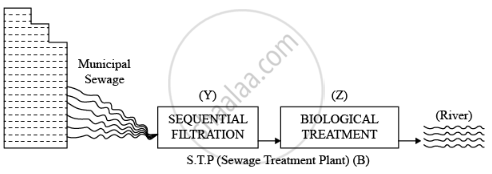
- Which one of the two 'S.T.P.' (A) or (B) will be more effective in treating the human excreta in municipal waste?
- Write the steps followed in carrying the treatment of the sewage in step (Z), once the BOD of sewage is reduced significantly till it is passed on to the "anaerobic sludge digesters".
Biochemical Oxygen Demand (BOD) may not be good index for pollution for water bodies receiving effluents from ______.
Explain the steps involved in preliminary treatment of sewage.
During primary sewage treatment, floating debris is separated by which physical process?
In a sewage treatment plant, grit comprising soil and small pebbles is removed during which stage and process?
What happens to the polluting potential of wastewater as its Biochemical Oxygen Demand (BOD) increases?
