Advertisements
Advertisements
प्रश्न
The figure below represents the vertical section of a leaf:
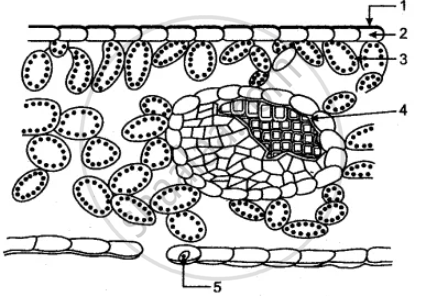
(i) Name the parts 1 to 5.
(ii) How many veins have been shown?
(iii) State the functions of parts 4 and 5.
Advertisements
उत्तर
(i)
- Cuticle
- Upper Epidermis
- Palisade tissue/chloroplast
- Xylem
- Stomata
(ii) One vein has been shown.
(iii) Xylem – helps in the conduction of water.
Stomata – through which exchange of gases takes place.
संबंधित प्रश्न
Give appropriate biological/technical terms for the following:
An apparatus that measures the rate of water uptake in a cut shoot due to transpiration.
Give one example of An aquatic plant used in the laboratory to demonstrate O2 liberation during photosynthesis
A candidate studied the importance of certain factors in photosynthesis. He took a potted plant and kept in the dark for over 24 hours. In the early hours of the next morning, he covered one of the leaves with black paper in the centre only. Then he placed the plant in sunlight for a few hours and tested the leaf which was covered with black paper for starch.
Describe step by step, how the candidate proceeded to test the leaf for the presence of starch?
Mention, if the following statement is True or False. If false rewrite the wrong statement in its correct form:
The dark reaction of Photosynthesis is light-independent.
What will happen if we remove plants from the aquarium?
What will happen if you breathe through mouth?
A plant is kept in a dark room for about 24 hours before conducting any experiment on photosynthesis in order to ______.
What is the end product of photosynthesis?
Arrange and rewrite the terms in the group in the correct order to be in a logical sequence beginning with the term that is underlined:
Snake, Rabbit, Cabbage, Hawk.
