Advertisements
Advertisements
प्रश्न
The equation of a wave travelling on a string stretched along the X-axis is given by
\[y = A e {}^- \left( \frac{x}{a} + \frac{t}{T} \right)^2 .\]
(a) Write the dimensions of A, a and T. (b) Find the wave speed. (c) In which direction is the wave travelling? (d) Where is the maximum of the pulse located at t = T? At t = 2 T?
Advertisements
उत्तर
Given,
Equation of the wave travelling on a string stretched along the X-axis:
\[y = Ae {}^\left( \frac{x}{a} + \frac{t}{T} \right) {{}^-}^2 \]
(a) The dimensions of A (amplitude), T (time period) and \[a = \frac{\lambda}{2\pi}\] , which will have the dimensions of the wavelength, are as follows:
\[\left[ A \right] = \left[ M^0 L^1 T^0 \right]\]
\[\left[ T \right] = \left[ M^0 L^0 T^{- 1} \right]\]
\[\left[ a \right] = \left[ M^0 L^1 T^0 \right]\]
(b) Wave speed, \[\nu = \frac{\lambda}{T} = \frac{a}{T} \left[ \lambda = a \right]\]
(c) If \[y = f \left( t + \frac{x}{\nu} \right)\] , then the wave travels in the negative direction; and if \[y = f \left( t - \frac{x}{\nu} \right)\] ,then the wave travels in the positive direction.
Thus, we have:
`"y"="Ae"^[[(x/a)+(t/T)]^(-2)]`
\[ = A e^{- \frac{1}{T} \left[ t + \left( \frac{xT}{a} \right) \right]^2} \]
\[ = A e^{- \frac{1}{T}\left[ t + \frac{x}{V} \right]} \]
\[ = A e^{- f\left[ t + \frac{x}{V} \right]}\]
Hence, the wave is travelling is the negative direction.
(d) Wave speed, \[v = \frac{a}{t}\] Maximum pulse at t = T = \[\left( \frac{a}{T} \right) \times T = a\] (Along the negative x - axis)
Maximum pulse at t = 2T = \[\left( \frac{a}{T} \times 2T \right) = 2a \] (Along the negative x - axis)
Therefore, the wave is travelling in the negative x-direction.
APPEARS IN
संबंधित प्रश्न
You have learnt that a travelling wave in one dimension is represented by a function y= f (x, t)where x and t must appear in the combination x – v t or x + v t, i.e. y = f (x ± v t). Is the converse true? Examine if the following functions for y can possibly represent a travelling wave:
(a) `(x – vt )^2`
(b) `log [(x + vt)/x_0]`
(c) `1/(x + vt)`
(i) For the wave on a string described in Exercise 15.11, do all the points on the string oscillate with the same (a) frequency, (b) phase, (c) amplitude? Explain your answers. (ii) What is the amplitude of a point 0.375 m away from one end?
Show that the particle speed can never be equal to the wave speed in a sine wave if the amplitude is less than wavelength divided by 2π.
A sine wave is travelling in a medium. A particular particle has zero displacement at a certain instant. The particle closest to it having zero displacement is at a distance
Choose the correct option:
Which of the following equations represents a wave travelling along Y-axis?
Two wave pulses travel in opposite directions on a string and approach each other. The shape of one pulse is inverted with respect to the other.
A sonometer wire of length l vibrates in fundamental mode when excited by a tuning fork of frequency 416. Hz. If the length is doubled keeping other things same, the string will ______.
The displacement of the particle at x = 0 of a stretched string carrying a wave in the positive x-direction is given f(t) = A sin (t/T). The wave speed is v. Write the wave equation.
A wave propagates on a string in the positive x-direction at a velocity \[\nu\] \[t = t_0\] is given by \[g\left( x, t_0 \right) = A \sin \left( x/a \right)\]. Write the wave equation for a general time t.
A 200 Hz wave with amplitude 1 mm travels on a long string of linear mass density 6 g m−1 kept under a tension of 60 N. (a) Find the average power transmitted across a given point on the string. (b) Find the total energy associated with the wave in a 2⋅0 m long portion of the string.
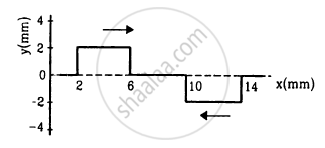
Following figure shows two wave pulses at t = 0 travelling on a string in opposite directions with the same wave speed 50 cm s−1. Sketch the shape of the string at t = 4 ms, 6 ms, 8 ms, and 12 ms.
Speed of sound wave in air ______.
A string of mass 2.5 kg is under a tension of 200 N. The length of the stretched string is 20.0 m. If the transverse jerk is struck at one end of the string, the disturbance will reach the other end in ______.
A transverse harmonic wave on a string is described by y(x, t) = 3.0 sin (36t + 0.018x + π/4) where x and y are in cm and t is in s. The positive direction of x is from left to right.
- The wave is travelling from right to left.
- The speed of the wave is 20 m/s.
- Frequency of the wave is 5.7 Hz.
- The least distance between two successive crests in the wave is 2.5 cm.
At what temperatures (in °C) will the speed of sound in air be 3 times its value at O°C?
A steel wire has a length of 12 m and a mass of 2.10 kg. What will be the speed of a transverse wave on this wire when a tension of 2.06 × 10⁴N is applied?
Given below are some functions of x and t to represent the displacement of an elastic wave.
- y = 5 cos (4x) sin (20t)
- y = 4 sin (5x – t/2) + 3 cos (5x – t/2)
- y = 10 cos [(252 – 250) πt] cos [(252 + 250)πt]
- y = 100 cos (100πt + 0.5x)
State which of these represent
- a travelling wave along –x direction
- a stationary wave
- beats
- a travelling wave along +x direction.
Given reasons for your answers.
The amplitude of wave disturbance propagating in the positive x-direction given is by `1/(1 + x)^2` at time t = 0 and `1/(1 + (x - 2)^2)` at t = 1 s, where x and y are in 2 metres. The shape of wave does not change during the propagation. The velocity of the wave will be ______ m/s.
Two perfectly identical wires kept under tension are in unison. When the tension in the wire is increased by 1% then on sounding them together 3 beats are heard in 2 seconds. What is the frequency of each wire?
