Advertisements
Advertisements
प्रश्न
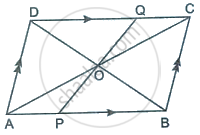
The diagonals AC and BD of a parallelogram ABCD intersect at ‘O’. A straight line through ‘O’ meets AB at P and DC at Q.
Prove that: area (◻APQD) = `1/2` × area (◻ABCD).
Advertisements
उत्तर
Given: In parallelogram ABCD, the diagonals AC and BD meet at O. A straight line through O meets AB at P and DC at Q.
To Prove: area (APQD) = `1/2` × area (ABCD).
Proof [Step-wise]:
1. In a parallelogram, the diagonals bisect each other.
So, O is the midpoint of AC and of BD (AO = OC and BO = OD).
2. Consider the half-turn rotation by 180° about O. This rotation is an isometry it preserves area and distances and it sends A ↔ C and B ↔ D because O is the midpoint of the diagonals.
3. The image of the line AB under this 180° rotation is the line DC.
Hence, the image of the point P which lies on AB is the point on DC at the same signed distance from O; that image is exactly Q.
Since Q is the intersection of the rotated line with the given line through O.
Thus, the rotation sends P to Q.
4. Therefore, the 180° rotation about O maps quadrilateral APQD to quadrilateral CQPB.
Because the rotation preserves area, area (APQD) = area (CQPB).
5. The two quadrilaterals APQD and CQPB are disjoint and together they fill the whole parallelogram ABCD.
So, area (APQD) + area (CQPB) = area (ABCD).
6. From steps 4 and 5, we get
2 × area (APQD) = area (ABCD).
Hence, area (APQD) = `1/2` × area (ABCD).
