Advertisements
Advertisements
प्रश्न
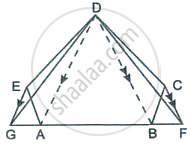
In the adjoining figure, ABCDE is a pentagon in which EG is drawn parallel to DA meets BA produced at G and CF is drawn parallel to DB meets AB produced at F. Prove that area of ABCDE = area of GDF.
Advertisements
उत्तर
Given: ABCDE is a pentagon with A, B on line GF (GABF collinear). EG is drawn parallel to DA and meets BA produced at G. CF is drawn parallel to DB and meets AB produced at F. D is the top vertex so GDF is the large triangle containing the pentagon as shown.
To Prove: area (ABCDE) = area (GDF).
Proof [Step-wise]:
1. Collinearity and basic decompositions.
Since G, A, B, F are collinear (GABF on one straight line), the big triangle GDF can be split along A and B into three triangles:
area (GDF) = area (ΔDGA) + area (ΔDAB) + area (ΔDBF)
The pentagon ABCDE can be partitioned into three triangles with common vertex D:
area (ABCDE) = area (ΔDEA) + area (ΔDAB) + area (ΔDBC)
So, it is enough to show area (ΔDGA) = area (ΔDEA) and area (ΔDBF) = area (ΔDBC).
2. Equality of the left-hand small triangles.
EG || DA by construction.
Consider the two triangles ΔDGA and ΔDEA.
Using the vector/area or oriented-area expression for triangle area.
area (ΔDGA) = `1/2` |(GD) × (AD)|
And area(ΔDEA) = `1/2` |(ED) × (AD)|
Their difference equals `1/2` |(GE) × (AD)|.
But EG || DA means (GE) is parallel to (AD).
So, the cross product (GE) × (AD) = 0.
Hence, area (ΔDGA) = area (ΔDEA).
3. Equality of the right-hand small triangles.
By the same argument, using CF || DB, we get
area (ΔDBF) = area (ΔDBC)
4. Combine equalities.
Substitute into the decompositions from step 1:
area (GDF) = area (ΔDGA) + area (ΔDAB) + area (ΔDBF)
= area (ΔDEA) + area (ΔDAB) + area (ΔDBC)
= area (ABCDE)
area (ABCDE) = area (GDF).
