Advertisements
Advertisements
प्रश्न
In the adjoining figure, ΔABC is a right-angled triangle, right-angled at B; ABDE and ACGF are the squares. If BH is perpendicular to FG.
Prove that:
- area (ΔΕAC) = area (ΔΒΑF).
- area (◻ABDE) = area (◻AIHF).
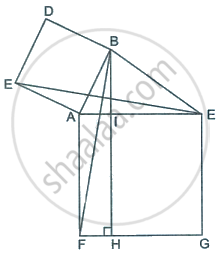
Advertisements
उत्तर
Given:
ΔABC is a right–angled at B
ABDE and ACGF are squares
BH ⟂ FG
To Prove:
- area (ΔEAC) = area (ΔBAF)
- area (◻ABDE) = area (◻AIHF)
i. Prove area (ΔEAC) = area (ΔBAF)
Observations:
Both ΔEAC and ΔBAF are right triangles.
Squares ABDE and ACGF give us:
AB = AD = AE
AC = AG = AF
Let’s focus on triangles EAC and BAF:
Triangle EAC lies on square ABDE.
Triangle BAF lies on square ACGF.
Both are formed using sides of equal length from the squares.
Now, observe that both triangles are formed between sides of equal length and with equal included angles because:
∠EAC = ∠BAF = 90° ...(Since they are right angles from square construction)
Side AE = AB, AF = AC
So triangles EAC and BAF are congruent, or at least have equal base and height.
Thus, `"area" (ΔEAC) = 1/2 xx AE xx AC`
= `1/2 xx AB xx AF`
= area (ΔBAF)
Hence proved.
ii. Prove area (◻ABDE) = area (◻AIHF)
Given:
ABDE is a square on side AB.
AIHF is constructed using point H, foot of perpendicular from B to FG and lies within square ACGF .
From the figure:
AIHF is a square formed on side AI = AB. ...(Since BH is perpendicular and forms a right angle)
Both squares ABDE and AIHF are on sides of equal length.
So, area (◻ABDE) = AB2
area (◻AIHF) = AI2 = AB2
Hence proved.
