Advertisements
Advertisements
प्रश्न
The currents flowing in the two coils of self-inductance L1 = 16 mH and L2 = 12 mH are increasing at the same rate. If the power supplied to the two coil is equal, find the ratio of the currents ?
Advertisements
उत्तर
Power, \[P = IV\]
\[\frac{I_1}{I_2} = \frac{V_2}{V_1} \left( \text { as P } \text { is same } \right)\]
\[ \Rightarrow \frac{I_1}{I_2} = \frac{3}{4}\]
APPEARS IN
संबंधित प्रश्न
An average emf of 20 V is induced in an inductor when the current in it is changed from 2.5 A in one direction to the same value in the opposite direction in 0.1 s. Find the self-inductance of the inductor.
A graph of magnetic flux `(phi)` versus current (I) is shown for four inductors A, B, C and D. Larger value of self-inductance is for inductor ____________.

The self-inductance associated with a coil is independent of ______.
A coil of wire of a certain radius has 600 turns and a self-inductance is 108 mH. The self-inductance of a second similar coil of 500 turns will be:
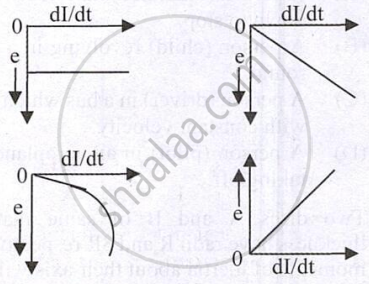
The current flowing through an inductor of self-inductance L is continuously increasing at constant rate. The variation of induced e.m.f. (e) verses dI/dt is shown graphically by figure
What property of a coil is called self-inductance?
What is the dimensional formula of self-inductance?
What is the SI unit of both self-inductance and mutual inductance?
Which applications are associated with self-inductance and mutual inductance, respectively?
