Advertisements
Advertisements
प्रश्न
The bob A of a pendulum released from horizontal to the vertical hits another bob B of the same mass at rest on a table as shown in figure.
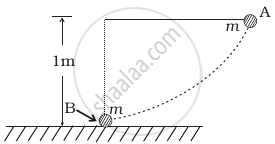
If the length of the pendulum is 1 m, calculate
- the height to which bob A will rise after collision.
- the speed with which bob B starts moving. Neglect the size of the bobs and assume the collision to be elastic.
Advertisements
उत्तर
a. Two balls have the same mass and the collision between them is elastic, therefore, ball A transfers its entire linear momentum to ball 8. Hence, ball A will come to rest after the collision and does not rise at all.

b. Speed with which bob B starts moving
= Speed with which bob A hits bob B
= `sqrt(2gh)`
= `sqrt(2 xx 9.8 xx 1)`
= `sqrt(19.6)`
= 4.42 m/s
APPEARS IN
संबंधित प्रश्न
In an inelastic collision of two bodies, the quantities which do not change after the collision are the ______ of the system of two bodies.
Answer carefully, with reason:
In an elastic collision of two billiard balls, is the total kinetic energy conserved during the short time of collision of the balls (i.e. when they are in contact)?
Answer carefully, with reason:
Is the total linear momentum conserved during the short time of an elastic collision of two balls?
Answer carefully, with reason:
In an inelastic collision of two billiard balls, is the total kinetic energy conserved during the short time of collision of the balls (i.e., when they are in contact)?
A molecule in a gas container hits a horizontal wall with speed 200 m s–1 and angle 30° with the normal, and rebounds with the same speed. Is momentum conserved in the collision? Is the collision elastic or inelastic?
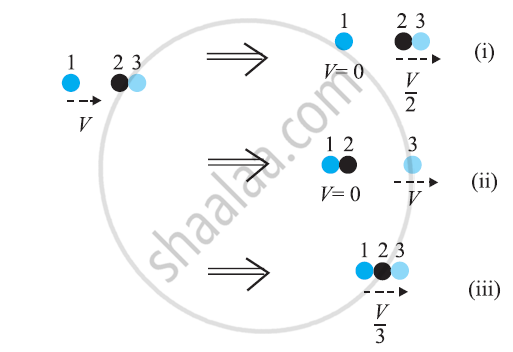
Two identical ball bearings in contact with each other and resting on a frictionless table are hit head-on by another ball bearing of the same mass moving initially with a speed V. If the collision is elastic, which of the following figure is a possible result after collision?
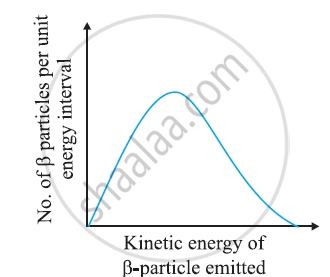
Consider the decay of a free neutron at rest : n → p + e–
Show that the two-body decay of this type must necessarily give an electron of fixed energy and, therefore, cannot account for the observed continuous energy distribution in the β-decay of a neutron or a nucleus
Answer the following question.
Obtain its value for an elastic collision and a perfectly inelastic collision.
Define the following:
Coefficient of restitution
What is inelastic collision? In which way it is different from an elastic collision. Mention a few examples in day-to-day life for inelastic collision.
Two different unknown masses A and B collide. A is initially at rest when B has a speed v. After collision B has a speed v/2 and moves at right angles to its original direction of motion. Find the direction in which A moves after the collision.
In Rutherford experiment, for head-on collision of a-particles with a gold nucleus, the impact parameter is ______.
A bomb of mass 9 kg explodes into two pieces of mass 3 kg and 6 kg. The velocity of mass 3 kg is 16 m/s, The kinetic energy of mass 6 kg is ____________.
A wooden block of mass 'M' moves with velocity 'v ' and collides with another block of mass '4M' which is at rest. After collision, the block of mass 'M' comes to rest. The coefficient of restitution will be ______.
Two bodies of masses 3 kg and 2 kg collide bead-on. Their relative velocities before and after collision are 20 m/s and 5 m/s respectively. The loss of kinetic energy of the system is ______.
A cricket ball of mass 150 g moving with a speed of 126 km/h hits at the middle of the bat, held firmly at its position by the batsman. The ball moves straight back to the bowler after hitting the bat. Assuming that collision between ball and bat is completely elastic and the two remain in contact for 0.001s, the force that the batsman had to apply to hold the bat firmly at its place would be ______.
Two pendulums with identical bobs and lengths are suspended from a common support such that in rest position the two bobs are in contact (Figure). One of the bobs is released after being displaced by 10° so that it collides elastically head-on with the other bob.
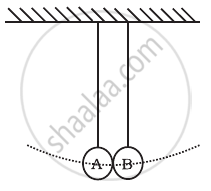
- Describe the motion of two bobs.
- Draw a graph showing variation in energy of either pendulum with time, for 0 ≤ t ≤ 2T, where T is the period of each pendulum.
A ball is thrown upwards from the foot of a tower. The ball crosses the top of tower twice after an interval of 4 seconds and the ball reaches ground after 8 seconds, then the height of tower is ______ m. (g = 10 m/s2)
In a collision, what type of interaction occurs between objects?
