Advertisements
Advertisements
प्रश्न
Consider the decay of a free neutron at rest : n → p + e–
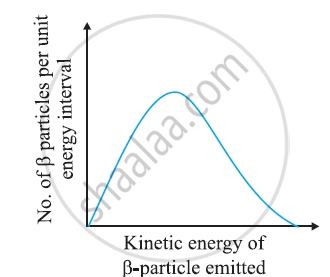
Show that the two-body decay of this type must necessarily give an electron of fixed energy and, therefore, cannot account for the observed continuous energy distribution in the β-decay of a neutron or a nucleus
Advertisements
उत्तर १
The decay process of free neutron at rest is given as:
n → p + e–
From Einstein’s mass-energy relation, we have the energy of electron as Δmc2
Where,
Δm = Mass defect = Mass of neutron – (Mass of proton + Mass of electron)
c = Speed of light
Δm and c are constants. Hence, the given two-body decay is unable to explain the continuous energy distribution in the β-decay of a neutron or a nucleus. The presence of neutrino νon the LHS of the decay correctly explains the continuous energy distribution.
उत्तर २
Let the masses of the electron and proton be m and M respectively. Let v and V be the velocities of electron and proton respectively. Using law of conservation of momentum. Momentum of electron + momentum of proton = momentum of neutron
`:. mv + MV = 0 => V = - m/M v`
Clearly the electron and the proton move in opposite directions. If mass `trianglem` has been conveted into energy in the reaction then
`1/2mv^2 + 1/2 MV^2 = trianglem xx c^2`
or `1/2mv^2 + 1/2M[-m/M]^2v^2 = trianglemc^2`
or `1/2mv^2[1+m/M] = trianglemc^2`
or `v^2 = (2Mtrianglemc^2)/(m(M+m))`
Thus, it is proved that the value of v2 is fixed since all the quantities in right hand side are constant. It establishes that the emitted electron must have a fixed energy and thus we cannot account for the continuous energy distribution in the β-decay of a neutron.
संबंधित प्रश्न
The rate of change of total momentum of a many-particle system is proportional to the ______ on the system.
In an inelastic collision of two bodies, the quantities which do not change after the collision are the ______ of the system of two bodies.
State if the following statement is true or false. Give a reason for your answer.
In an elastic collision of two bodies, the momentum and energy of each body is conserved.
A bullet of mass 0.012 kg and horizontal speed 70 m s–1 strikes a block of wood of mass 0.4 kg and instantly comes to rest with respect to the block. The block is suspended from the ceiling by means of thin wires. Calculate the height to which the block rises. Also, estimate the amount of heat produced in the block.
Define coefficient of restitution.
Answer the following question.
Discuss the following as special cases of elastic collisions and obtain their exact or approximate final velocities in terms of their initial velocities.
- Colliding bodies are identical.
- A very heavy object collides on a lighter object, initially at rest.
- A very light object collides on a comparatively much massive object, initially at rest.
Solve the following problem.
A ball of mass 100 g dropped on the ground from 5 m bounces repeatedly. During every bounce, 64% of the potential energy is converted into kinetic energy. Calculate the following:
- Coefficient of restitution.
- The speed with which the ball comes up from the ground after the third bounce.
- The impulse was given by the ball to the ground during this bounce.
- Average force exerted by the ground if this impact lasts for 250 ms.
- The average pressure exerted by the ball on the ground during this impact if the contact area of the ball is 0.5 cm2.
Solve the following problem.
A spring ball of mass 0.5 kg is dropped from some height. On falling freely for 10 s, it explodes into two fragments of mass ratio 1:2. The lighter fragment continues to travel downwards with a speed of 60 m/s. Calculate the kinetic energy supplied during the explosion.
Explain the characteristics of elastic and inelastic collision.
Define the following:
Coefficient of restitution
A ball moving with velocity 5 m/s collides head on with another stationary ball of double mass. If the coefficient of restitution is 0.8, then their velocities (in m/s) after collision will be ____________.
A bullet fired from gun with a velocity 30 m/s at an angle of 60° with horizontal direction. At the highest point of its path, the bullet explodes into two parts with masses in the ratio 1:3. The lighter mass comes to rest immediately. Then the speed of the heavier mass is
A cricket ball of mass 150 g moving with a speed of 126 km/h hits at the middle of the bat, held firmly at its position by the batsman. The ball moves straight back to the bowler after hitting the bat. Assuming that collision between ball and bat is completely elastic and the two remain in contact for 0.001s, the force that the batsman had to apply to hold the bat firmly at its place would be ______.
Three identical blocks A, B and C are placed on horizontal frictionless surface. The blocks A and C are at rest. But A is approaching towards B with a speed 10 m/s. The coefficient of restitution for all collision is 0.5. The speed of the block C just after the collision is ______.

Answer carefully, with reason:
Is the total linear momentum conserved during the short time of an inelastic collision of two balls ?
What is a collision?
