Advertisements
Advertisements
प्रश्न
The accompanying Venn diagram shows three events, A, B, and C, and also the probabilities of the various intersections (for instance, P(A ∩ B) = .07). Determine P(A ∪ B)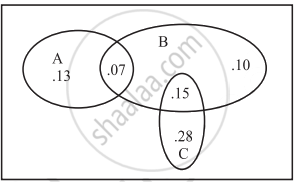
Advertisements
उत्तर
From the given Venn diagram
P(A ∪ B) = P(A) + P(B) – P(A ∩ B)
= 0.13 + 0.07 + 0.07 + 0.10 + 0.15 – 0.07
= 0.13 + 0.07 + 0.10 + 0.15
= 0.45
APPEARS IN
संबंधित प्रश्न
A die is thrown, find the probability of following events:
- A prime number will appear,
- A number greater than or equal to 3 will appear,
- A number less than or equal to one will appear,
- A number more than 6 will appear,
- A number less than 6 will appear.
A card is selected from a pack of 52 cards.
- How many points are there in the sample space?
- Calculate the probability that the card is an ace of spades.
- Calculate the probability that the card is
- an ace
- black card.
There are four men and six women on the city council. If one council member is selected for a committee at random, how likely is it that it is a woman?
A fair coin is tossed four times, and a person win Re 1 for each head and lose Rs 1.50 for each tail that turns up.
From the sample space calculate how many different amounts of money you can have after four tosses and the probability of having each of these amounts.
Three coins are tossed once. Find the probability of getting
- 3 heads
- 2 heads
- at least 2 heads
- at most 2 heads
- no head
- 3 tails
- exactly two tails
- no tail
- atmost two tails.
In a lottery, person chooses six different natural numbers at random from 1 to 20, and if these six numbers match with the six numbers already fixed by the lottery committee, he wins the prize. What is the probability of winning the prize in the game? [Hint: order of the numbers is not important.]
Check whether the following probabilities P(A) and P(B) are consistently defined
P(A) = 0.5, P(B) = 0.7, P(A ∩ B) = 0.6
Check whether the following probabilities P(A) and P(B) are consistently defined
P(A) = 0.5, P(B) = 0.4, P(A ∪ B) = 0.8
Fill in the blank in following table:
| P(A) | P(B) | P(A ∩ B) | P(A ∪ B) |
| 0.35 | ... | 0.25 | 0.6 |
Fill in the blank in following table:
| P(A) | P(B) | P(A ∩ B) | P(A ∪ B) |
| 0.5 | 0.35 | .... | 0.7 |
Two unbiased dice are thrown. Find the probability that the total of the numbers on the dice is greater than 10.
Two unbiased dice are thrown. Find the probability that neither a doublet nor a total of 8 will appear
Two unbiased dice are thrown. Find the probability that the sum of the numbers obtained on the two dice is neither a multiple of 2 nor a multiple of 3
A bag contains 8 red, 3 white and 9 blue balls. If three balls are drawn at random, determine the probability that all the three balls are blue balls
If a letter is chosen at random from the English alphabet, find the probability that the letter is a vowel .
In a lottery, a person chooses six different numbers at random from 1 to 20, and if these six numbers match with six number already fixed by the lottery committee, he wins the prize. What is the probability of winning the prize in the game?
Which of the cannot be valid assignment of probability for elementary events or outcomes of sample space S = {w1, w2, w3, w4, w5, w6, w7}:
| Elementary events: | w1 | w2 | w3 | w4 | w5 | w6 | w7 |
| (ii) |
\[\frac{1}{7}\]
|
\[\frac{1}{7}\]
|
\[\frac{1}{7}\]
|
\[\frac{1}{7}\]
|
\[\frac{1}{7}\]
|
\[\frac{1}{7}\]
|
\[\frac{1}{7}\]
|
Which of the cannot be valid assignment of probability for elementary events or outcomes of sample space S = {w1, w2, w3, w4, w5, w6, w7}:
| Elementary events: | w1 | w2 | w3 | w4 | w5 | w6 | w7 |
| (iv) |
\[\frac{1}{14}\]
|
\[\frac{2}{14}\]
|
\[\frac{3}{14}\]
|
\[\frac{4}{14}\]
|
\[\frac{5}{14}\]
|
\[\frac{6}{14}\]
|
\[\frac{15}{14}\]
|
In a single throw of three dice, find the probability of getting the same number on all the three dice.
An urn contains twenty white slips of paper numbered from 1 through 20, ten red slips of paper numbered from 1 through 10, forty yellow slips of paper numbered from 1 through 40, and ten blue slips of paper numbered from 1 through 10. If these 80 slips of paper are thoroughly shuffled so that each slip has the same probability of being drawn. Find the probabilities of drawing a slip of paper that is numbered 1, 2, 3, 4 or 5
In a leap year the probability of having 53 Sundays or 53 Mondays is ______.
Three squares of chessboard are selected at random. The probability of getting 2 squares of one colour and other of a different colour is ______.
Four candidates A, B, C, D have applied for the assignment to coach a school cricket team. If A is twice as likely to be selected as B, and B and C are given about the same chance of being selected, while C is twice as likely to be selected as D, what are the probabilities that C will be selected?
The accompanying Venn diagram shows three events, A, B, and C, and also the probabilities of the various intersections (for instance, P(A ∩ B) = .07). Determine `P(A ∩ barB)`
In a non-leap year, the probability of having 53 tuesdays or 53 wednesdays is ______.
Three numbers are chosen from 1 to 20. Find the probability that they are not consecutive ______.
While shuffling a pack of 52 playing cards, 2 are accidentally dropped. Find the probability that the missing cards to be of different colours ______.
Seven persons are to be seated in a row. The probability that two particular persons sit next to each other is ______.
Without repetition of the numbers, four-digit numbers are formed with the numbers 0, 2, 3, 5. The probability of such a number divisible by 5 is ______.
The probability that a person visiting a zoo will see the giraffee is 0.72, the probability that he will see the bears is 0.84 and the probability that he will see both is 0.52.
The probabilities that a typist will make 0, 1, 2, 3, 4, 5 or more mistakes in typing a report are, respectively, 0.12, 0.25, 0.36, 0.14, 0.08, 0.11.
The sum of probabilities of two students getting distinction in their final examinations is 1.2
The probability that the home team will win an upcoming football game is 0.77, the probability that it will tie the game is 0.08, and the probability that it will lose the game is ______.
| C1 Probability |
C2 Written Description |
| (a) 0.95 | (i) An incorrect assignment |
| (b) 0.02 | (ii) No chance of happening |
| (c) – 0.3 | (iii) As much chance of happening as not |
| (d) 0.5 | (iv) Very likely to happen |
| (e) 0 | (v) Very little chance of happening |
