Advertisements
Advertisements
प्रश्न
Sulphuric acid reacts with sodium hydroxide as follows:
\[\ce{H2SO4 + 2NaOH -> Na2SO4 + 2H2O}\]
When 1 L of 0.1 M sulphuric acid solution is allowed to react with 1 L of 0.1 M sodium hydroxide solution, the amount of sodium sulphate formed and its molarity in the solution obtained is:
(i) 0.1 mol L–1
(ii) 7.10 g
(iii) 0.025 mol L–1
(iv) 3.55 g
Advertisements
उत्तर
(ii) 7.10 g
(iii) 0.025 mol L–1
Explanation:
0.1 mole \[\ce{H2SO4}\] reacts with 1 mole of \[\ce{NaOH}\].
0.1 mole of \[\ce{NaOH}\] will react with `0.1/2` mole of \[\ce{H2SO4}\].
Here, \[\ce{NaOH}\] is the limiting reagent.
2 mole of \[\ce{NaOH}\] produces 1 mole of \[\ce{Na2SO4}\].
0.1 mole of \[\ce{NaOH}\] will give `0.1/2` mole of \[\ce{Na2SO4}\].
No. of mole = `"Given mass"/("Molar mass" (Na_2SO_4))`
On substituting the value in tha above equation, the mass can be calculated as 0.05 mol = `"Given mass"/(142 g mol^-1)`
Given mass = 7.10 g
Volume of solution after mixing is 2 L.
So, the molarity of \[\ce{Na2SO4}\] is,
Molarity = `0.05/2` = 0.025 mol L–1
APPEARS IN
संबंधित प्रश्न
To make a saturated solution, 36 g of sodium chloride is dissolved in 100 g of water at 293 K. Find its concentration at this temperature.
Calculate the amount of carbon dioxide that could be produced when 1 mole of carbon is burnt in air.
What is the concentration of sugar (C12H22O11) in mol L–1 if its 20 g are dissolved in enough water to make a final volume up to 2 L?
Calculate the molarity of a solution of ethanol in water in which the mole fraction of ethanol is 0.040 (assume the density of water to be one).
To make a saturated solution, 36 g of sodium chloride is dissolved in 100 g of water at 293 K. Find its concentration at this temperature.
Why does the molarity of a solution depend upon temperature?
Solve the following problem:
Find out the molar mass of the following compounds:
Mohr’s salt [FeSO4(NH4)2SO4.6H2O]
(At. mass: Cu = 63.5; S = 32; O = 16; H = 1; Na = 23; C = 12; Fe = 56; N = 14)
Solve the following problem:
Write the following number in ordinary decimal form:
0.00477 × 10⁵
Solve the following problem:
Perform the following calculation. Round off your answer to two digits.
`1/(3.40xx10^24)`
Solve the following problem:
Perform the following calculation. Round off your answer to two digits.
`(1.4xx10^9)/((2.77xx10^3)(3.76xx10^5))`
Perform the following calculation. Round off your answer to three digits.
(8.39 107) (4.53 109)
Solve the following problem:
Perform the following calculation. Round off your answer to three digits.
`((9.28xx10^9)(9.9xx10^-7))/((511)(2.98xx10^-6))`
A 1.000 mL sample of acetone, a common solvent used as a paint remover, was placed in a small bottle whose mass was known to be 38.0015 g.
The following values were obtained when the acetone-filled bottle was weighed: 38.7798 g, 38.7795 g and 38.7801 g. How would you characterise the precision and accuracy of these measurements if the actual mass of the acetone was 0.7791 g?
Solve the following problem:
The hourly energy requirements of an astronaut can be satisfied by the energy released when 34 grams of sucrose are “burnt” in his body. How many grams of oxygen would be needed to be carried in space capsule to meet his requirement for one day?
What are the favourable qualities given to gold when it is alloyed with copper or silver for the purpose of making ornaments?
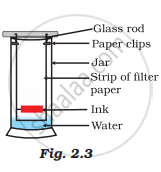
A child wanted to separate the mixture of dyes constituting a sample of ink. He marked a line by the ink on the filter paper and placed the filter paper in a glass containing water as shown in Fig.2.3. The filter paper was removed when the water moved near the top of the filter paper.
(i) What would you expect to see, if the ink contains three different coloured components?
(ii) Name the technique used by the child.
(iii) Suggest one more application of this technique.
If 500 mL of a 5 M solution is diluted to 1500 mL, what will be the molarity of the solution obtained?
Which of the following solutions have the same concentration?
(i) \[\ce{20 g of NaOH in 200 mL of solution}\]
(ii) \[\ce{0.5 mol of KCl in 200 mL of solution}\]
(iii) \[\ce{40 g of NaOH in 100 mL of solution}\]
(iv) \[\ce{20 g of KOH in 200 mL of solution}\]
Match the following physical quantities with units
| Physical quantity | Unit |
| (i) Molarity | (a) g mL–1 |
| (ii) Mole fraction | (b) mol |
| (iii) Mole | (c) Pascal |
| (iv) Molality | (d) Unitless |
| (v) Pressure | (e) mol L–1 |
| (vi) Luminous intensity | (f) Candela |
| (vii) Density | (g) mol kg–1 |
| (viii) Mass | (h) Nm–1 |
| (i) kg |
Molarity is ______.
