Advertisements
Advertisements
प्रश्न
Study the following phrases and their meanings. Use them appropriately to complete the sentences that follow.
If you want to go out, I will ………….. the children for you.
पर्याय
look after: take care of
look down on: disapprove or regard as inferior
look in (on someone): make a short visit
look into: investigate
look out: be careful
look up: improve
look up to: admire
Advertisements
उत्तर
If you want to go out, I will look after the children for you.
संबंधित प्रश्न
Answer the following question in not more than 100 − 150 words.
How does the author describe Kathmandu’s busiest streets?
The Mystery of Bermuda Triangle.
More complex Connectors
Read through the following text. Pay special attention to the underlined words. These help the reader to understand the relationship between sentences, or the parts of sentences, clearly.
Select as many appropriate words as possible from the list given below to replace the underlined words. Be careful not to change the basic meaning too much.
| to his amazement | even though |
| although | in actual fact |
| as a matter of fact | lastly |
| generally | usually |
| however | nevertheless |
| besides | to his surprise |
| asarule | all the same. |
Martin’s Picture
Margin wasn’t a very bright boy. Normally, he never came more than second from the bottom in any test. But, that morning in the art lesson, he had drawn a beautiful picture of a scarecrow in a field of yellow corn. To his astonishment, the drawing was the only one given full marks – ten out of ten – which made him for the first time in his life the best in the class! He had proudly pinned the picture up on the wall behind his desk, where it could be admired by all. It seemed though, that not everyone admired it. Some unknown member of the class had, in fact, taken a violent dislike to it.
During the lunch break, when the classroom had been deserted, the picture had been torn off the wall. Moreover, it had been trodden or stamped on. As if that wasn’t enough, the words ‘ROTTEN RUBBISH’ had been written on the back in big round letters. And finally, the paper was so creased that it looked as though it had been screwed up into a tight ball and perhaps thrown about the room.
“Who could have done it?” Martin wondered.
Now rewrite the text.
Martin’s picture
Martin wasn’t a very bright boy.
Usually,
Generally
As a rule, He never came more than second from the bottom in any test.
However,…. ______________________
Six humans trapped by happenstance
In black and bitter cold.
Each one possessed a stick of wood,
Or so the story's told.
Their dying fire in need of logs;
The first man held his back.
For on the faces around the fire,
He noticed one was black.
Read the lines given above and answer the question that follow:
Why does the poet use this diction?
Six humans trapped by happenstance
In black and bitter cold.
Each one possessed a stick of wood,
Or so the story's told.
Their dying fire in need of logs;
The first man held his back.
For on the faces around the fire,
He noticed one was black.
Read the lines given above and answer the question that follow:
Explain the symbolism used by the poet.
Old Kaspar took it from the boy,
Who stood expectant by;
And then the old man shook his head,
And,with a natural sigh,
"Tis some poor fellow's skull," said he,
"Who fell in the great victory.
"I find them in the garden,
For there's many here about;
And often when I go to plough,
The ploughshare turns them out!
For many thousand men,"said he,
"Were slain in that great victory."
Read the lines given above and answer the question that follow.
What did Old Kasper do when Peterkin came to him with the object?
For oft, when on my couch I lie
In vacant or in pensive mood,
They flash upon that inward eye
Which is the bliss of solitude;
And then my heart with pleasure fills,
And dances with the daffodils.
Read the lines given above and answer the question that follow.
Explain with reference to context.
“You haven’t brought home that sick brat!” Anger and astonishment were in the tones of Mrs. Joe Thompson; her face was in a flame.
“I think women’s hearts are sometimes very hard,” said Joe. Usually Joe Thompson got out of his wife’s way, or kept rigidly silent and non-combative when she fired up on any subject; it was with some surprise, therefore, that she now encountered a firmly-set countenance and a resolute pair of eyes.
“Women’s hearts are not half so hard as men’s!”
Joe saw, by a quick intuition, that his resolute bearing h«d impressed his wife and he answered quickly, and with real indignation, “Be that as it may, every woman at the funeral turned her eyes steadily from the sick child’s face, and when the cart went off with her dead mother, hurried away, and left her alone in that old hut, with the sun not an hour in the sky.”
“Where were John and Kate?” asked Mrs. Thompson.
“Farmer Jones tossed John into his wagon, and drove off. Katie went home with Mrs. Ellis; but nobody wanted the poor sick one. ‘Send her to the poorhouse,’ was the cry.”
“Why didn’t you let her go, then. What did you bring her here for?”
“She can’t walk to the poorhouse,” said Joe; “somebody’s arms must carry her, and mine are strong enough for that task.”
Read the extract given below and answer the question that follow.
What kind of person does Mrs Thompson appear to be?
Read the extract given below and answer the questions that follow:
.......Once again Clover and Benjamin warned him to take care of his health, but Boxer paid, no attention. His twelfth birthday was approaching. He did not care what happened so long as a good store of stone was accumulated before he went on a pension.
Late one evening, in the summer, a sudden rumor ran round the farm that something had happened to Boxer. He had gone out alone to drag a load of stone down to the windmill. And sure enough, the rumor was true….
(i) In what condition did the animals find Boxer?
(ii) Why did the animals feel uneasy when Squealer told them that Boxer would be sent to a hospital at Willingdon for treatment?
How did Squealer reassure them?
(iii) How much longer did Boxer expect to live?
How did he plan to spend his remaining days?
(iv) What was written on the van that took Boxer away? What did Boxer do when he heard the screams of the animals?
(v) What was the new name given to Animal Farm by Napoleon?
What strange transformation did the animals notice on the faces of the pigs?
What is the significance of this transformation?
Find in the poem an antonym (a word opposite in meaning) of the following word
grow
What made Nishad turn sympathetic towards Mr Nath?
What happened to the ball bearings?
How did the two baby birds get separated?
Make noun from the word given below by adding –ness, ity, ty or y
honest ___________.
There are twelve words hidden in this table. Six can be found horizontally and the remaining six vertically. All of them are describing words like ‘good’, ‘happy’, etc. The first letters of the words are given below:
Horizontal: H R F F S G
Vertical: A W S F L Q 2020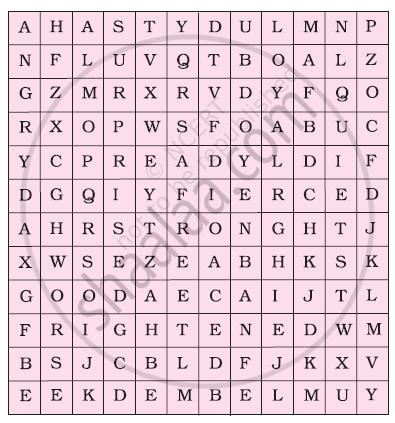
A. Strike off the words in the box below that are not suitable.
Taro wanted to give his old parents everything they needed.
This shows that he was …
|
thoughtful |
hardworking |
loving |
honest |
|
considerate |
trustworthy |
efficient |
kind |
Use the phrase in a sentence of your own, after finding out its meaning.
broke apart
Answer the following question.
What was Algu’s verdict as head Panch? How did Jumman take it?
Does Nishad agree with Maya about Mr Nath? How does he feel about him?
The words helper, companion, partner and accomplice have very similar meanings, but each word is typically used in certain phrases. Can you fill in the blanks below with the most commonly used words? A dictionary may help you.
the thief’s ……………
