Advertisements
Advertisements
प्रश्न
Solve the following Linear Programming Problems graphically:
Minimise Z = 3x + 5y
such that x + 3y ≥ 3, x + y ≥ 2, x, y ≥ 0.
Advertisements
उत्तर
The system of constraints is:
x + 3y ≥ 3 ....(i)
x + y ≥ 2 ....(ii)
and x, y ≥ 0 ....(iii)
Let l1 : x + 3y = 3
l2 : x + y = 2
The shaded region in the figure is the feasible region determined by the system of constraints (i) to (iii).
The feasible region is unbounded.
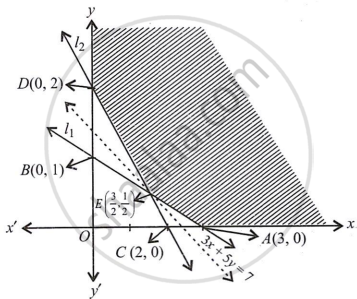
We use the corner point method to determine the minimum value of Z,
We have,
Z = 3x + 5y
The co-ordinated of A, E and D are (3, 0), `(3/2, 1/2).`
(on solving x + 3y = 3 and x + y = 2) and (0, 2) respectively.
We evaluate Z at each corner point
| Corner point | Corresponding value of Z |
| (3, 0) | 9 |
| `(3/2, 1/2)` | 7 (Minimum) |
| (0, 2) | 10 |
Now, Since the region is unbounded we need to check whether 7 is the minimum value or not. To decide this, we graph the inequality 3x + 5y < 7.
Now, in the graph, we observe that 7 does not have points in common with a feasible region.
So, 7 is the minimum value at Z.
Hence, Zmin = 7 at `(3/2, 1/2)`
APPEARS IN
संबंधित प्रश्न
Solve the following Linear Programming Problems graphically:
Maximise Z = 3x + 2y
subject to x + 2y ≤ 10, 3x + y ≤ 15, x, y ≥ 0.
Solve the following Linear Programming Problems graphically:
Minimise Z = x + 2y
subject to 2x + y ≥ 3, x + 2y ≥ 6, x, y ≥ 0.
If the feasible region for a linear programming problem is bounded, then the objective function Z = ax + by has both a maximum and a minimum value on R.
Maximise Z = 3x + 4y, subject to the constraints: x + y ≤ 1, x ≥ 0, y ≥ 0
Determine the maximum value of Z = 3x + 4y if the feasible region (shaded) for a LPP is shown in Figure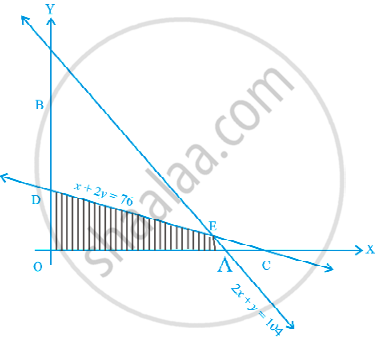
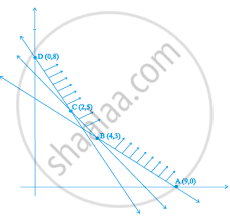
Feasible region (shaded) for a LPP is shown in Figure. Maximise Z = 5x + 7y.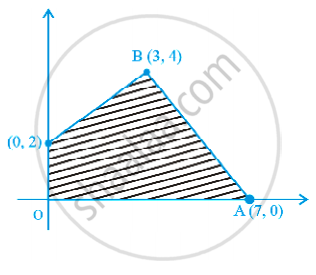
The feasible region for a LPP is shown in Figure. Find the minimum value of Z = 11x + 7y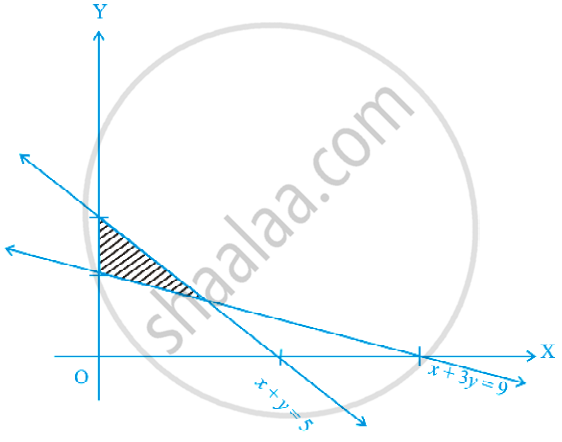
Maximise Z = x + y subject to x + 4y ≤ 8, 2x + 3y ≤ 12, 3x + y ≤ 9, x ≥ 0, y ≥ 0.
A company makes 3 model of calculators: A, B and C at factory I and factory II. The company has orders for at least 6400 calculators of model A, 4000 calculator of model B and 4800 calculator of model C. At factory I, 50 calculators of model A, 50 of model B and 30 of model C are made every day; at factory II, 40 calculators of model A, 20 of model B and 40 of model C are made everyday. It costs Rs 12000 and Rs 15000 each day to operate factory I and II, respectively. Find the number of days each factory should operate to minimise the operating costs and still meet the demand.
Refer to Question 27. Maximum of Z occurs at ______.
Corner points of the feasible region for an LPP are (0, 2), (3, 0), (6, 0), (6, 8) and (0, 5). Let F = 4x + 6y be the objective function. The Minimum value of F occurs at ______.
In a LPP, the linear inequalities or restrictions on the variables are called ____________.
In a LPP, the objective function is always ______.
If the feasible region for a LPP is ______ then the optimal value of the objective function Z = ax + by may or may not exist.
In a LPP if the objective function Z = ax + by has the same maximum value on two corner points of the feasible region, then every point on the line segment joining these two points give the same ______ value.
In a LPP, the maximum value of the objective function Z = ax + by is always finite.
Based on the given shaded region as the feasible region in the graph, at which point(s) is the objective function Z = 3x + 9y maximum?

In a linear programming problem, the constraints on the decision variables x and y are x − 3y ≥ 0, y ≥ 0, 0 ≤ x ≤ 3. The feasible region:
Objective function of a linear programming problem is ____________.
Z = 7x + y, subject to 5x + y ≥ 5, x + y ≥ 3, x ≥ 0, y ≥ 0. The minimum value of Z occurs at ____________.
A linear programming problem is one that is concerned with ____________.
In linear programming, optimal solution ____________.
Maximize Z = 3x + 5y, subject to x + 4y ≤ 24, 3x + y ≤ 21, x + y ≤ 9, x ≥ 0, y ≥ 0.
Maximize Z = 4x + 6y, subject to 3x + 2y ≤ 12, x + y ≥ 4, x, y ≥ 0.
Maximize Z = 6x + 4y, subject to x ≤ 2, x + y ≤ 3, -2x + y ≤ 1, x ≥ 0, y ≥ 0.
Maximize Z = 10×1 + 25×2, subject to 0 ≤ x1 ≤ 3, 0 ≤ x2 ≤ 3, x1 + x2 ≤ 5.
The feasible region for an LPP is shown shaded in the following figure. Minimum of Z = 4x + 3y occurs at the point.
Which expression has the general form of an objective function with constants \(a\) and \(b\)?
In the expression \[Z=250x+75y\], which quantities are the decision variables?
What are constraints in a Linear Programming Problem?
Which condition represents non-negative restrictions for two decision variables?
Which statement defines an Optimisation Problem?
What are restrictions on decision variables called in linear programming?
