Advertisements
Advertisements
प्रश्न
Solve the following equation by factorization
3x2= x + 4
Advertisements
उत्तर
3x2 = x + 4
⇒ 3x2 – x – 4 = 0
⇒ 3x2 – 4x + 3x – 4 = 0
⇒ x (3x - 4) + 1 (3x - 4) = 0
⇒ (3x - 4) (x + 1) = 0
Either 3x - 4 = 0,
then 3x = 4
⇒ x = `(4)/(3)`
or
x + 1 = 0,
then x = -1
Hence x = `(4)/(3), -1`.
APPEARS IN
संबंधित प्रश्न
Find the roots of the following quadratic equation by factorisation:
100x2 – 20x + 1 = 0
Solve the following quadratic equations by factorization:
(x − 4) (x + 2) = 0
Solve the following quadratic equations by factorization:
ax2 + (4a2 − 3b)x − 12ab = 0
A plane left 40 minutes late due to bad weather and in order to reach its destination, 1600 km away in time, it had to increase its speed by 400 km/hr from its usual speed. Find the usual speed of the plane.
The hypotenuse of a right triangle is 25 cm. The difference between the lengths of the other two sides of the triangle is 5 cm. Find the lengths of these sides.
Find the value of k for which the following equations have real and equal roots:
\[\left( k + 1 \right) x^2 - 2\left( k - 1 \right)x + 1 = 0\]
Solve the following equation: 25x (x + 1) = -4
Solve the following equation by factorization
(x – 3) (2x + 5) = 0
If Zeba were younger by 5 years than what she really is, then the square of her age (in years) would have been 11 more than five times her actual age. What is her age now?
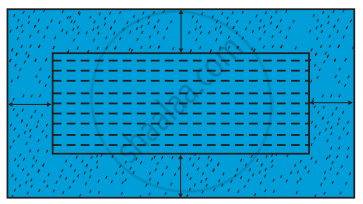
In the centre of a rectangular lawn of dimensions 50 m × 40 m, a rectangular pond has to be constructed so that the area of the grass surrounding the pond would be 1184 m2 [see figure]. Find the length and breadth of the pond.