Advertisements
Advertisements
प्रश्न
Soft iron is used to make the core of the transformer because of its ______.
पर्याय
Low coercivity and low retentivity
Low coercivity and high retentivity
High coercivity and high retentivity
High coercivity and low retentivity
Advertisements
उत्तर
Soft iron is used to make the core of the transformer because of its Low coercivity and low retentivity.
Explanation:
Soft iron is used to make the core of transformers because of its high permeability. This enables complete magnetic flux coupling from the main coil to the secondary coil, and it possesses low retentivity and low coercivity.
संबंधित प्रश्न
State any two advantages of electromagnets over permanent magnets.
State how magnetic susceptibility is different for the three types of magnetic materials, i.e. diamagnetic, paramagnetic and ferromagnetic materials
State two advantages of an electromagnet over a permanent magnet.
Write two characteristics of a material used for making permanent magnets ?
Why should the material used for making permanent magnets have high coercivity?
Magnetic scalar potential is defined as `U(vec r_2) - U(vec r_1) = - ∫_vec(r_1)^vec(r_2)` `vec (B) . dvec(l)`
Apply this equation to a closed curve enclosing a long straight wire. The RHS of the above equation is then `-u_0 i` by Ampere's law. We see that `U(vec(r_2)) ≠ U(vec(r_1))` even when `vec r_2 =vec r_1` .Can we have a magnetic scalar potential in this case?
A dip circle is taken to geomagnetic equator. The needle is allowed to move in a vertical plane perpendicular to the magnetic meridian. The needle will stay ______.
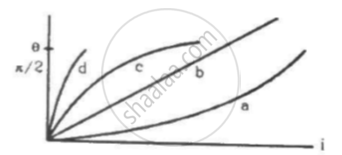
Which of the following four graphs may best represent the current-deflection relation in a tangent galvanometer?
A very long bar magnet is placed with its north pole coinciding with the centre of a circular loop carrying as electric current i. The magnetic field due to the magnet at a point on the periphery of the wire is B. The radius of the loop is a. The force on the wire is
To measure the magnetic moment of a bar magnet, one may use
(a) a tangent galvanometer
(b) a deflection galvanometer if the earth's horizontal field is known
(c) an oscillation magnetometer if the earth's horizontal field is known
(d) both deflection and oscillation magnetometer if the earth's horizontal field is not known
The magnetic field at a point, 10 cm away from a magnetic dipole, is found to be `2.0 xx 10^-4 "T"` . Find the magnetic moment of the dipole if the point is (a) in end-on position of the dipole and (b) in broadside-on position of the dipole.
Show that the magnetic field at a point due to a magnetic dipole is perpendicular to the magnetic axis if the line joining the point with the centre of the dipole makes an angle of `tan^-1(sqrt 2)` with the magnetic axis
The desirable properties for making permanent magnets are _________________ .
The coercive force for a certain permanent magnet is 4.0 × 10⁴ A m−1. This magnet is placed inside a long solenoid of 40 turns/cm and a current is passed in the solenoid to demagnetise it completely. Find the current.
The magnetic moment of the assumed dipole at the earth's centre is 8.0 × 10²² A m2. Calculate the magnetic field B at the geomagnetic poles of the earth. Radius of the earth is 6400 km.
A magnetic needle is free to rotate in a vertical plane which makes an angle of 60° with the magnetic meridian. If the needle stays in a direction making an angle of `tan^-1(2sqrt(3))` with the horizontal, what would be the dip at that place?
A short magnet produces a deflection of 37° in a deflection magnetometer in Tan-A position when placed at a separation of 10 cm from the needle. Find the ratio of the magnetic moment of the magnet to the earth's horizontal magnetic field.
The magnetometer of the previous problem is used with the same magnet in Tan-B position. Where should the magnet be placed to produce a 37° deflection of the needle?
A short magnet makes 40 oscillations per minute when used in an oscillation magnetometer at a place where the earth's horizontal magnetic field is 25 μT. Another short magnet of magnetic moment 1.6 A m2 is placed 20 cm east of the oscillating magnet. Find the new frequency of oscillation if the magnet has its north pole (a) towards north and (b) towards south.
In a permanent magnet at room temperature ______.
A wire of length 2 m carrier of lamp is bend to form a circle. The magnetic moment of a coil is :-
Which of the following is most suitable for the core of an electromagnet?
Which magnetic properties are desirable for making a permanent magnet?
