मराठी
कर्नाटक बोर्ड पी.यू.सी.पीयूसी विज्ञान इयत्ता ११

Figure Shows Some of the Equipotential Surfaces of the Magnetic Scalar Potential. Find the Magnetic Field B at a Point in the Region. - Physics

Advertisements
Advertisements

प्रश्न

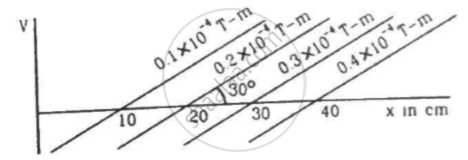
Figure shows some of the equipotential surfaces of the magnetic scalar potential. Find the magnetic field B at a point in the region.
बेरीज
Advertisements

उत्तर

Given : 

Perpendicular distance, `dx = 10  sin 30^circ "cm" = 0.05  "m"` ,

Change in the potential, dV = `0.1 xx 10^-4  "T-m"`

We know that the relation between the potential and the field is given by 

`B = -(dV)/(dx)`

⇒ `B = -(0.1 xx 10^-4  "T-m")/(5 xx 10^-2  "m")`

⇒ `B = -2 xx 10^-4  "T"`

B is perpendicular to the equipotential surface. Here, it is at angle of 120° with the positive x-axis.

shaalaa.com
  या प्रश्नात किंवा उत्तरात काही त्रुटी आहे का?
पाठ 14: Permanent Magnets - Exercises [पृष्ठ २७७]

APPEARS IN

एचसी वर्मा Concepts of Physics Vol. 2 [English] Class 11 and 12
पाठ 14 Permanent Magnets
Exercises | Q 4 | पृष्ठ २७७

संबंधित प्रश्‍न

Write two characteristics of a material used for making permanent magnets ?


Why is the core of an electromagnet made of ferromagnetic materials?


Compare the direction of the magnetic field inside a solenoid with that of the field there if the solenoid is replaced by its equivalent combination of north pole and south pole.


Magnetic scalar potential is defined as `U(vec r_2) - U(vec r_1) = - ∫_vec(r_1)^vec(r_2)` `vec (B) . dvec(l)`

Apply this equation to a closed curve enclosing a long straight wire. The RHS of the above equation is then `-u_0 i` by Ampere's law. We see that `U(vec(r_2)) ≠ U(vec(r_1))` even when `vec r_2 =vec r_1` .Can we have a magnetic scalar potential in this case?


Which of the following four graphs may best represent the current-deflection relation in a tangent galvanometer?


If the current is doubled, the deflection is also doubled in


To measure the magnetic moment of a bar magnet, one may use

(a) a tangent galvanometer
(b) a deflection galvanometer if the earth's horizontal field is known
(c) an oscillation magnetometer if the earth's horizontal field is known
(d) both deflection and oscillation magnetometer if the earth's horizontal field is not known


A uniform magnetic field of `0.20 xx 10^-3  "T"`  exists in the space. Find the change in the magnetic scalar potential as one moves through 50 cm along the field.


The magnetic moment of the assumed dipole at the earth's centre is 8.0 × 10²² A m2. Calculate the magnetic field B at the geomagnetic poles of the earth. Radius of the earth is 6400 km.


A moving-coil galvanometer has a 50-turn coil of size 2 cm × 2 cm. It is suspended between the magnetic poles producing a magnetic field of 0.5 T. Find the torque on the coil due to the magnetic field when a current of 20 mA passes through it.


A short magnet produces a deflection of 37° in a deflection magnetometer in Tan-A position when placed at a separation of 10 cm from the needle. Find the ratio of the magnetic moment of the magnet to the earth's horizontal magnetic field.


Which property of soft iron makes it useful for preparing electromagnet?


What should be retentivity and coercivity of permanent magnet?


Answer in brief.

Explain one application of electromagnet.


In a permanent magnet at room temperature ______.


The hysteresis cycle for the material of permanent magnet is ______.

The materials suitable for making electromagnets should have ______.

A steel wire of length 1 has a magnetic moment m it is then bent into a semicircular arc. The new magnetic moment is


Which of the following is most suitable for the core of an electromagnet?


Which magnetic properties are desirable for making a permanent magnet?


Share
Notifications

Englishहिंदीमराठी


      Forgot password?
Use app×