Advertisements
Advertisements
प्रश्न
Select the correct option:
When an object sinks in a liquid, its:
पर्याय
buoyant force is more than the weight of object
buoyant force is less than the weight of an object
buoyant force is equal to the weight of the object
none of the above
Advertisements
उत्तर
buoyant force is less than the weight of object
APPEARS IN
संबंधित प्रश्न
In what direction does the buoyant force on an object immersed in a liquid act?
The weight of a body floating in a liquid is ........
Explain why an iron needle sinks in water, but a ship made of iron floats on water.
The pressure P1 at a certain depth in river water and P2 at the same depth in sea water are related as :
A hammer exerts a force of 1.5 N on each of the two nails A and B. The area of cross section of tip of nail A is 2 mm2 while that of nail B is 6 mm2. Calculate pressure on each nail in pascal.
Why is a force needed to keep a block of wood inside water?
Two spheres A and B, each of volume 100 cm3 is placed on water (density = 1.0 g cm−3). The sphere A is made of wood of density 0.3 g cm−3 and sphere B is made of iron of density 8.9 g cm−3.
- Find:
- The weight of each sphere, and
- The upthrust on each sphere.
- Which sphere will float? Give reason.
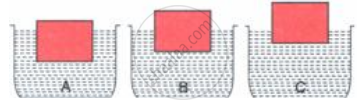
Figure shows the same block of wood floating in three different liquids A, B and C of densities ρ1, ρ2 and ρ3 respectively. Which of the liquid has the highest density? Give a reason for your answer.
What do you mean by buoyancy?
What is meant by up thrust?
