Advertisements
Advertisements
प्रश्न
Two spheres A and B, each of volume 100 cm3 is placed on water (density = 1.0 g cm−3). The sphere A is made of wood of density 0.3 g cm−3 and sphere B is made of iron of density 8.9 g cm−3.
- Find:
- The weight of each sphere, and
- The upthrust on each sphere.
- Which sphere will float? Give reason.
Advertisements
उत्तर
Volume of sphere A & B = 100 cm3
Density of water = 1 g cm−3
Density of sphere A = 0.3 g cm−3
Density of sphere B = 8.9 g cm−3
(a)
(i) Weight of sphere A = (density of sphere A × volume) × g
= 0.3 × 100 × g = 30 gf
Weight of sphere B = (density of sphere B × volume × g)
= 8.9 × 100 × g = 890 gf
(ii) Upthrust on sphere A = Volume of sphere A × density of water × g
= 100 × 1 × g = 100 gf
Upthrust on sphere B = Volume of sphere B × density of water × g
= 100 × 1 × g = 100 gf
Since the volume of both spheres is the same inside water, the upthrust acting on them will also be the same.
(b) The sphere A will float because the density of wood is less than the density of water.
APPEARS IN
संबंधित प्रश्न
What happens to the buoyant force as more and more volume of a solid object is immersed in a liquid ? When does the buoyant force become maximum ?
The density of aluminium is 2.7 g cm-3 and that of brass 8.4 g cm’3. The correct statement is
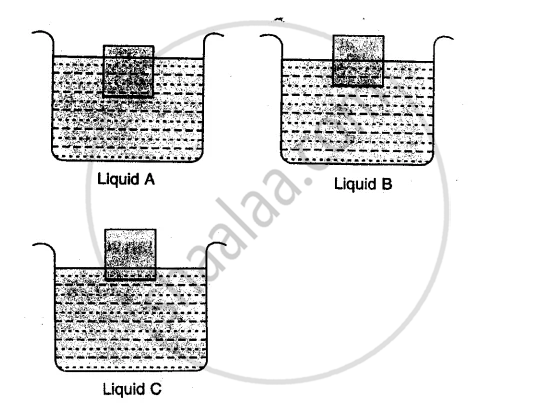
The diagram given below show a body floating in three different liquids. A, B and C at different levels.
(a) In which liquid does the body experience the greatest buoyant force?
(b) Which liquid has the least density?
(c) Which liquid has the highest density?
A piece of wood if left under water comes to the surface. Explain the reason.
A balloon filled with helium gas floats in a big closed jar which is connected to an evacuating pump. What will be your observation, if air from the jar is pumped out? Explain your answer.
The blood pressure reading of a patient is recorded 160/100. Express the lower pressure in SI units.
[Take density of mercury as 13.6 × 10³ kgm−3 and the value of ‘g’ as 10 ms−2]
Consider the statement given below and choose the correct option.
Assertion: Water strider slides easily on the surface of the water.
Reason: Water strider experiences less buoyant force.
The magnitude of buoyant force acting on an object immersed in a liquid depends on ______ of the liquid.
Most buoyant objects are those with relatively ______.
- high volume
- higher mass
- low density
- less viscosity
If the buoyant force is less, the object will float.
