Advertisements
Advertisements
प्रश्न
Select the correct option:
The phenomenon due to which a solid experiences upward force when immersed in water is called:
पर्याय
floatation
buoyancy
density
none of these
Advertisements
उत्तर
buoyancy
APPEARS IN
संबंधित प्रश्न
Why does a block of wood held under water rise to the surface when released ?
Which of the following will sink or float on water? (Density of water = 1 g Cm-3)
body D having density 0.85 g m-3
Why does it happen?
A ship dips to a larger depth in fresh water as compared to marine water.
Describe a simple experiment to demonstrate that a liquid enclosed in a vessel exerts pressure in all directions.
The diagram below in Fig. 4.12 shows a device which makes the use of the principle of transmission of pressure.
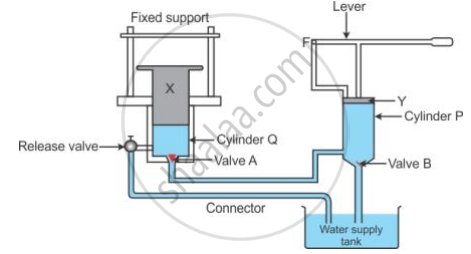
- Name the parts labelled by the letters X and Y.
- Describe what happens to valves A and B and to the quantity of water in the two cylinders when the lever arm is moved down.
- Give reasons for what happens to valves A and B in part (ii).
- What happens when the release valve is opened?
- What happens to valve B in cylinder P when the lever arm is moved up?
- Give a reason for your answer in part (v).
- State one use of the above device.
The pressure P1 at a certain depth in river water and P2 at the same depth in sea water are related as :
Prove that the loss in weight of a body when immersed wholly or partially in a liquid is equal to the buoyant force (or upthrust) and this loss is because of the difference in pressure exerted by liquid on the upper and lower surfaces of the submerged part of body.
Complete the following sentence.
Mass = .................... × density
A homogeneous block floats on water (a) partly immersed (b) completely immersed. In each case state the position of centre of buoyancy B with respect to the centre of gravity G of the block.
Select the correct option.
The unit Nm2 is the unit of
