Advertisements
Advertisements
प्रश्न
The magnitude of buoyant force acting on an object immersed in a liquid depends on ______ of the liquid.
Advertisements
उत्तर
The magnitude of buoyant force acting on an object immersed in a liquid depends on density of the liquid.
APPEARS IN
संबंधित प्रश्न
In what direction does the buoyant force on an object immersed in a liquid act?
Name the force which makes heavy objects appear light when immersed in a liquid.
What is the cause of buoyant force ?
A boy get into a floating boat.
What happens to the buoyant force on the boat ?
The pressure P1 at a certain depth in river water and P2 at the same depth in sea water are related as :
(i) The diameter of neck and bottom of a bottle are 2 cm and 10 cm, respectively. The bottle is completely filled with oil. If the cork in the neck is pressed in with a force of 1.2 kgf, what force is exerted on the bottom of the bottle?
(ii) Name the law/principle you have used to find the force in part (a).
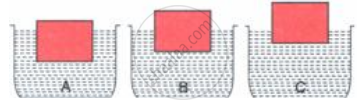
Figure shows the same block of wood floating in three different liquids A, B and C of densities ρ1, ρ2 and ρ3 respectively. Which of the liquid has the highest density? Give a reason for your answer.
Select the correct option:
The phenomenon due to which a solid experiences upward force when immersed in water is called:
Is thrust a scalar or vector quantity?
The upward force that is caused due to the pressure difference in liquid (or fluid) is called ______.
