Advertisements
Advertisements
प्रश्न
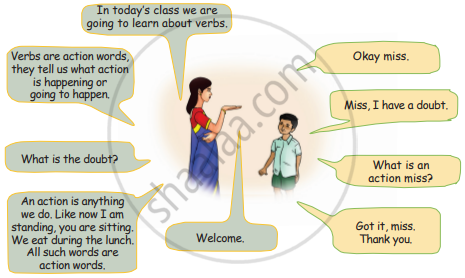
See how they speak at this situation and practise as if you were in that situation. A teacher is teaching the class.
Advertisements
उत्तर
| Teacher | In today’s class we are going to learn about verbs. |
| Student | Okay miss. |
| Teacher | Verbs are action words, they tell us what action is happening or going to happen. |
| Student | Miss, I have a doubt. |
| Teacher | What is the doubt? |
| Student | What is an action miss? |
| Teacher | An action is anything we do. Like now I am standing, you are sitting. We eat during the lunch. All such words are action words. |
| Student | Got it, miss. Thank you. |
| Teacher | Welcome. |
APPEARS IN
संबंधित प्रश्न
Form groups and use the ICT lab of your Junior College to make a short film on the script that you have prepared. There are several soft-wares that can be used for editing. You can take professional help. One can upload his/her film on mediums like Youtube and submit the link to the subject teacher.
Figures of speech
Consonance: Repetition of similar consonant sounds in the neighbouring words.
(e.g.) It's the prettiest little parlour that ever you did spy; Pick out one more instance of consonance from the poem.
Collect images of some electronic gadgets and play a JAM (just a minute) game by picking one image and talking for a minute about it in your classroom.
“Where does Helen live?”
Jim wants to know where ______.
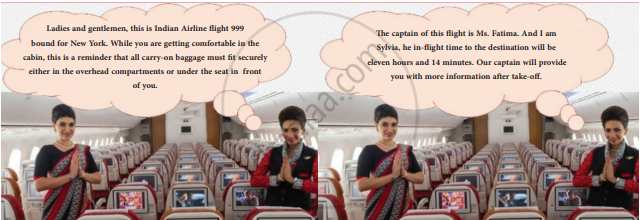
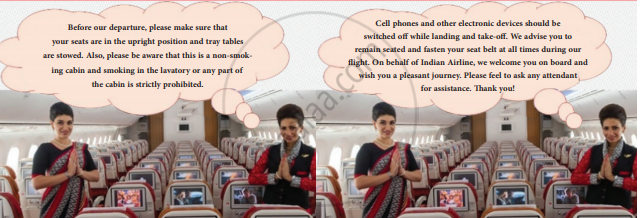
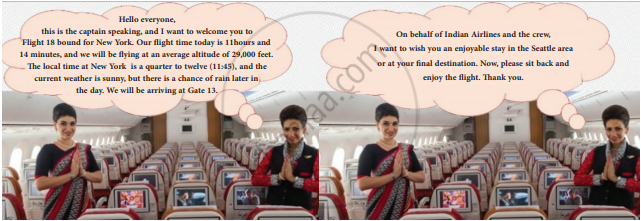
Read the story board and take roles as pilot and flight attendants to enact the scene.
Inflight Passenger Announcements
In your family, what activities are done individually and as a group?
| My mother decides | |
| My father decides | |
| I decide | |
| We decide |
How do you think you can help children who cannot see?
As a friend of the narrator, describe how you would have behaved at the auction.
Build a dialogue of 8–10 exchanges between your friend and yourself, on the following situation:
You were to board a train to Delhi. By mistake, you got into the wrong train and fought for your seat there. On realising your mistake, you left the train shamefaced, after creating a commotion there. Role-play this situation before the class.
- The Vellore was h held in 1801.
- The family members of Tippu were imprisoned at Vellore Fort after the fourth Mysore war.
- At the time of Vellore revolt, the Governor of Madras was lord William Bentinck.
- The victory of revolt of Vellore against British was one of the significant event in the history of india.
