मराठी
कर्नाटक बोर्ड पी.यू.सी.पीयूसी विज्ञान इयत्ता ११

Repeat the Previous Problem If the Particle C Is Displaced Through a Distance X Along the Line Ab. - Physics

Advertisements
Advertisements

प्रश्न

Repeat the previous problem if the particle C is displaced through a distance x along the line AB. 

टीपा लिहा
Advertisements

उत्तर
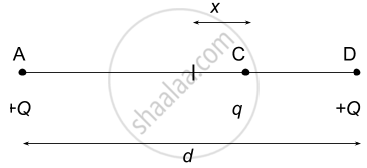
Net force

\[= \frac{1}{4\pi \in_0}\left[ \frac{Qq}{\left( \frac{d}{2} - x \right)^2} - \frac{Qq}{\left( \frac{d}{2} + x \right)^2} \right]\] 

\[ = \frac{Qq}{4\pi \in_0}\frac{\left[ \left( \frac{d}{2} \right)^2 + x^2 + xd - \left( \frac{d}{2} \right)^2 - x^2 + xd \right]}{\left[ \left( \frac{d}{2} \right)^2 - x^2 \right]^2}\]

when, 
x << d
So, net force = \[\frac{qQ}{4\pi \in_0}\frac{\left( 2xd \right)}{d^4}\] 

\[ = \frac{qQ}{4\pi \in_0}\frac{2x}{d^3}\] 

\[\text{ Or  m }\left( \frac{2\pi}{T} \right)^2 x = \frac{2xqQ}{4\pi \in_0 d^3}\] 

\[T =  \left[ \frac{\pi^3 \in_0 m d^3}{2Qq} \right]^{1/2}\]

shaalaa.com
  या प्रश्नात किंवा उत्तरात काही त्रुटी आहे का?
पाठ 7: Electric Field and Potential - Exercises [पृष्ठ १२२]

APPEARS IN

एचसी वर्मा Concepts of Physics Vol. 2 [English] Class 11 and 12
पाठ 7 Electric Field and Potential
Exercises | Q 33 | पृष्ठ १२२

संबंधित प्रश्‍न

Two equal balls with equal positive charge 'q' coulombs are suspended by two insulating strings of equal length. What would be the effect on the force when a plastic sheet is inserted between the two?


Four point charges q= 2 μC, q= −5 μC, qC = 2 μC, and qD = −5 μC are located at the corners of a square ABCD of side 10 cm. What is the force on a charge of 1 μC placed at the centre of the square?


Plot a graph showing the variation of coulomb force (F) versus ,`(1/r^2)` where is the distance between the two charges of each pair of charges: (1 μC, 2 μC) and (2 μC, − 3 μC). Interpret the graphs obtained.


A charge of 1.0 C is placed at the top of your college building and another equal charge at the top of your house. Take the separation between the two charges to be 2.0 km. Find the force exerted by the charges on each other. How many times your weight is this force?


At what separation should two equal charges, 1.0 C each, be placed, so that the force between them equals the weight of a 50 kg person? 


Estimate the number of electrons in 100 g of water. How much is the total negative charge on these electrons?


Suppose all the electrons of 100 g water are lumped together to form a negatively-charged particle and all the nuclei are lumped together to form a positively-charged particle. If these two particles are placed 10.0 cm away from each other, find the force of attraction between them. Compare it with your weight.


NaCl molecule is bound due to the electric force between the sodium and the chlorine ions when one electron of sodium is transferred to chlorine. Taking the separation between the ions to be 2.75 × 10⁻⁸ cm, find the force of attraction between them. State the assumptions (if any) that you have made. 


Two identical balls, each with a charge of 2.00 × 10⁻⁷ C and a mass of 100 g, are suspended from a common point by two insulating strings, each 50 cm long. The balls are held at a separation 5.0 cm apart and then released. Find. 

(a) the electric force on one of the charged balls

(b) the components of the resultant force on it along and perpendicular to the string

(c) the tension in the string

(d) the acceleration of one of the balls. Answers are to be obtained only for the instant just after the release.


Two identically-charged particles are fastened to the two ends of a spring of spring constant 100 N m−1 and natural length 10 cm. The system rests on a smooth horizontal table. If the charge on each particle is 2.0 × 10⁻⁸ C, find the extension in the length of the spring. Assume that the extension is small as compared to the natural length. Justify this assumption after you solve the problem.  


Two particles A and B, each carrying a charge Q, are held fixed with a separation dbetween them. A particle C of mass m and charge q is kept at the middle point of the line AB.  Assuming x<<d, show that this force is proportional to x.


Two particles A and B, each carrying a charge Q, are held fixed with a separation dbetween them. A particle C of mass m and charge q is kept at the middle point of the line AB.   Under what conditions will the particle C execute simple harmonic motion if it is released after such a small displacement? Find the time period of the oscillations if these conditions are satisfied.


Two equal charges, 2.0 × 10⁻⁷ C each, are held fixed at a separation of 20 cm. A third charge of equal magnitude is placed midway between the two charges. It is now moved to a point 20 cm from both the charges. How much work is done by the electric field during the process?


How much work has to be done in assembling three charged particles at the vertices of an equilateral triangle, as shown in the figure?


Solve numerical example.

Three equal charges of 10×10-8 C respectively, each located at the corners of a right triangle whose sides are 15 cm, 20 cm, and 25cm respectively. Find the force exerted on the charge located at the 90° angle.


Explain in detail Coulomb’s law and its various aspects.


Polarised dielectric is equivalent to ______.


Coulomb’s law is true for ______.

Coulomb's law is given by F = k q1q2 rn where n is 


There is another useful system of units, besides the SI/mks A system, called the cgs (centimeter-gram-second) system. In this system Coloumb’s law is given by

F = `(Qq)/r^2 hatr`

where the distance r is measured in cm (= 10–2 m), F in dynes (= 10–5 N) and the charges in electrostatic units (es units), where 1 es unit of charge = `1/([3]) xx 10^-9 C`

The number [3] actually arises from the speed of light in vaccum which is now taken to be exactly given by c = 2.99792458 × 10⁸ m/s. An approximate value of c then is c = [3] × 108 m/s.

(i) Show that the coloumb law in cgs units yields

1 esu of charge = 1 (dyne)1/2 cm.

Obtain the dimensions of units of charge in terms of mass M, length L and time T. Show that it is given in terms of fractional powers of M and L.

(ii) Write 1 esu of charge = x C, where x is a dimensionless number. Show that this gives

`1/(4pi ∈_0) = 10^-9/x^2 (N*m^2)/C^2`

With `x = 1/([3]) xx 10^-9`, we have `1/(4pi ∈_0) = [3]^2 xx 10^9 (Nm^2)/C^2`

or, `1/(4pi ∈_0) = (2.99792458)^2 xx 10^9 (Nm^2)/C^2` (exactly).


Share
Notifications

Englishहिंदीमराठी


      Forgot password?
Use app×