Advertisements
Advertisements
प्रश्न
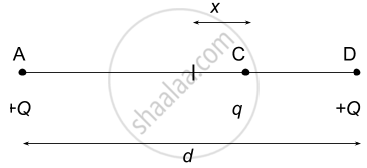
Repeat the previous problem if the particle C is displaced through a distance x along the line AB.
Advertisements
उत्तर
Net force
\[= \frac{1}{4\pi \in_0}\left[ \frac{Qq}{\left( \frac{d}{2} - x \right)^2} - \frac{Qq}{\left( \frac{d}{2} + x \right)^2} \right]\]
\[ = \frac{Qq}{4\pi \in_0}\frac{\left[ \left( \frac{d}{2} \right)^2 + x^2 + xd - \left( \frac{d}{2} \right)^2 - x^2 + xd \right]}{\left[ \left( \frac{d}{2} \right)^2 - x^2 \right]^2}\]
when,
x << d
So, net force = \[\frac{qQ}{4\pi \in_0}\frac{\left( 2xd \right)}{d^4}\]
\[ = \frac{qQ}{4\pi \in_0}\frac{2x}{d^3}\]
\[\text{ Or m }\left( \frac{2\pi}{T} \right)^2 x = \frac{2xqQ}{4\pi \in_0 d^3}\]
\[T = \left[ \frac{\pi^3 \in_0 m d^3}{2Qq} \right]^{1/2}\]
APPEARS IN
संबंधित प्रश्न
- Two insulated charged copper spheres A and B have their centers separated by a distance of 50 cm. What is the mutual force of electrostatic repulsion if the charge on each is 6.5 × 10⁻⁷ C? The radii of A and B are negligible compared to the distance of separation.
- What is the force of repulsion if each sphere is charged double the above amount, and the distance between them is halved?
Suppose that the particle is an electron projected with velocity vx = 2.0 × 10⁶ m s−1. If E between the plates separated by 0.5 cm is 9.1 × 10² N/C, where will the electron strike the upper plate? (|e| = 1.6 × 10⁻¹⁹ C, me = 9.1 × 10⁻³¹ kg)
NaCl molecule is bound due to the electric force between the sodium and the chlorine ions when one electron of sodium is transferred to chlorine. Taking the separation between the ions to be 2.75 × 10⁻⁸ cm, find the force of attraction between them. State the assumptions (if any) that you have made.
Suppose an attractive nuclear force acts between two protons which may be written as F=Ce−kr/r2. Write down the dimensional formulae and appropriate SI units of C and k.
A hydrogen atom contains one proton and one electron. It may be assumed that the electron revolves in a circle of radius 0.53 angstrom (1 angstrom = 10−10 m and is abbreviated as Å ) with the proton at the centre. The hydrogen atom is said to be in the ground state in this case. Find the magnitude of the electric force between the proton and the electron of a hydrogen atom in its ground state.
Find the speed of the electron in the ground state of a hydrogen atom. The description of ground state is given in the previous problem.
Ten positively-charged particles are kept fixed on the x-axis at points x = 10 cm, 20 cm, 30 cm, ...., 100 cm. the first particle has a charge 1.0 × 10⁻⁸ C, the second 8 × 10⁻⁸ C, the third 27 × 10−8 C and so on. The tenth particle has a charge 1000 × 10−8 C. Find the magnitude of the electric force acting on a 1 C charge placed at the origin.
A particle with a charge of 2.0 × 10⁻⁴ C is placed directly below and at a separation of 10 cm from the bob of a simple pendulum at rest. The mass of the bob is 100 g. What charge should the bob be given so that the string becomes loose?
Two particles A and B, each carrying a charge Q, are held fixed with a separation dbetween them. A particle C of mass m and charge q is kept at the middle point of the line AB. If it is displaced through a distance x perpendicular to AB, what would be the electric force experienced by it?
Two particles A and B possessing charges of +2.00 × 10⁻⁶ C and of −4.00 × 10⁻⁶ C, respectively, are held fixed at a separation of 20.0 cm. Locate the points (s) on the line AB, where (a) the electric field is zero (b) the electric potential is zero.
A point charge produces an electric field of magnitude 5.0 NC−1 at a distance of 40 cm from it. What is the magnitude of the charge?
A water particle of mass 10.0 mg and with a charge of 1.50 × 10⁻⁶ C stays suspended in a room. What is the magnitude of electric field in the room? What is its direction ?
What is relative permittivity?
Solve numerical example.
Three equal charges of 10×10-8 C respectively, each located at the corners of a right triangle whose sides are 15 cm, 20 cm, and 25cm respectively. Find the force exerted on the charge located at the 90° angle.
For charges q1 and q2 separated by a distance R the magnitude of the electrostatic force is given by ______.
Two charge – 10c and + 10 c are placed 10 cm apart. Potential at centre of the line joining the two charge is:-
Which of the following statements about nuclear forces is not true?
Two point charges +2 C and +6 C repel each other with a force of 12 N. If a charge of -4 C is given to each of these charges, then the force now is ______.