Advertisements
Advertisements
प्रश्न
Prove the following by using the principle of mathematical induction for all n ∈ N:
`1 + 3 + 3^2 + ... + 3^(n – 1) =((3^n -1))/2`
Advertisements
उत्तर
Let the given statement be P(n), i.e.,
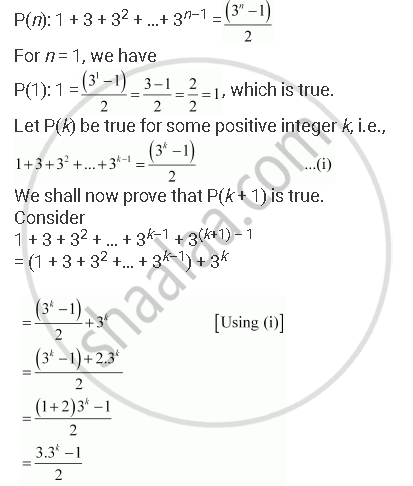
= `(3^(k+1) - 1)/2`
Thus, P(k + 1) is true whenever P(k) is true.
Hence, by the principle of mathematical induction, statement P(n) is true for all natural numbers i.e., n.
संबंधित प्रश्न
Prove the following by using the principle of mathematical induction for all n ∈ N:
`1^3 + 2^3 + 3^3 + ... + n^3 = ((n(n+1))/2)^2`
Prove the following by using the principle of mathematical induction for all n ∈ N:
Prove the following by using the principle of mathematical induction for all n ∈ N:
Prove the following by using the principle of mathematical induction for all n ∈ N:
Prove the following by using the principle of mathematical induction for all n ∈ N:
Prove the following by using the principle of mathematical induction for all n ∈ N:
`(1+ 1/1)(1+ 1/2)(1+ 1/3)...(1+ 1/n) = (n + 1)`
Prove the following by using the principle of mathematical induction for all n ∈ N:
`1/1.4 + 1/4.7 + 1/7.10 + ... + 1/((3n - 2)(3n + 1)) = n/((3n + 1))`
1 + 2 + 3 + ... + n = \[\frac{n(n + 1)}{2}\] i.e. the sum of the first n natural numbers is \[\frac{n(n + 1)}{2}\] .
1 + 3 + 32 + ... + 3n−1 = \[\frac{3^n - 1}{2}\]
\[\frac{1}{1 . 4} + \frac{1}{4 . 7} + \frac{1}{7 . 10} + . . . + \frac{1}{(3n - 2)(3n + 1)} = \frac{n}{3n + 1}\]
2 + 5 + 8 + 11 + ... + (3n − 1) = \[\frac{1}{2}n(3n + 1)\]
a + ar + ar2 + ... + arn−1 = \[a\left( \frac{r^n - 1}{r - 1} \right), r \neq 1\]
2.7n + 3.5n − 5 is divisible by 24 for all n ∈ N.
Prove that 1 + 2 + 22 + ... + 2n = 2n+1 - 1 for all n \[\in\] N .
Let P(n) be the statement : 2n ≥ 3n. If P(r) is true, show that P(r + 1) is true. Do you conclude that P(n) is true for all n ∈ N?
\[\frac{(2n)!}{2^{2n} (n! )^2} \leq \frac{1}{\sqrt{3n + 1}}\] for all n ∈ N .
\[\text{ Given } a_1 = \frac{1}{2}\left( a_0 + \frac{A}{a_0} \right), a_2 = \frac{1}{2}\left( a_1 + \frac{A}{a_1} \right) \text{ and } a_{n + 1} = \frac{1}{2}\left( a_n + \frac{A}{a_n} \right) \text{ for } n \geq 2, \text{ where } a > 0, A > 0 . \]
\[\text{ Prove that } \frac{a_n - \sqrt{A}}{a_n + \sqrt{A}} = \left( \frac{a_1 - \sqrt{A}}{a_1 + \sqrt{A}} \right) 2^{n - 1} .\]
\[\text{ A sequence } a_1 , a_2 , a_3 , . . . \text{ is defined by letting } a_1 = 3 \text{ and } a_k = 7 a_{k - 1} \text{ for all natural numbers } k \geq 2 . \text{ Show that } a_n = 3 \cdot 7^{n - 1} \text{ for all } n \in N .\]
Prove by method of induction, for all n ∈ N:
3 + 7 + 11 + ..... + to n terms = n(2n+1)
Prove by method of induction, for all n ∈ N:
12 + 22 + 32 + .... + n2 = `("n"("n" + 1)(2"n" + 1))/6`
Prove by method of induction, for all n ∈ N:
12 + 32 + 52 + .... + (2n − 1)2 = `"n"/3 (2"n" − 1)(2"n" + 1)`
Prove by method of induction, for all n ∈ N:
`1/(1.3) + 1/(3.5) + 1/(5.7) + ... + 1/((2"n" - 1)(2"n" + 1)) = "n"/(2"n" + 1)`
Answer the following:
Prove, by method of induction, for all n ∈ N
`1/(3.4.5) + 2/(4.5.6) + 3/(5.6.7) + ... + "n"/(("n" + 2)("n" + 3)("n" + 4)) = ("n"("n" + 1))/(6("n" + 3)("n" + 4))`
Answer the following:
Given that tn+1 = 5tn − 8, t1 = 3, prove by method of induction that tn = 5n−1 + 2
Answer the following:
Prove by method of induction 152n–1 + 1 is divisible by 16, for all n ∈ N.
Prove statement by using the Principle of Mathematical Induction for all n ∈ N, that:
`sum_(t = 1)^(n - 1) t(t + 1) = (n(n - 1)(n + 1))/3`, for all natural numbers n ≥ 2.
Show by the Principle of Mathematical Induction that the sum Sn of the n term of the series 12 + 2 × 22 + 32 + 2 × 42 + 52 + 2 × 62 ... is given by
Sn = `{{:((n(n + 1)^2)/2",", "if n is even"),((n^2(n + 1))/2",", "if n is odd"):}`
Prove the statement by using the Principle of Mathematical Induction:
For any natural number n, 7n – 2n is divisible by 5.
Prove the statement by using the Principle of Mathematical Induction:
n(n2 + 5) is divisible by 6, for each natural number n.
Prove the statement by using the Principle of Mathematical Induction:
1 + 5 + 9 + ... + (4n – 3) = n(2n – 1) for all natural numbers n.
A sequence b0, b1, b2 ... is defined by letting b0 = 5 and bk = 4 + bk – 1 for all natural numbers k. Show that bn = 5 + 4n for all natural number n using mathematical induction.
Show that `n^5/5 + n^3/3 + (7n)/15` is a natural number for all n ∈ N.
If xn – 1 is divisible by x – k, then the least positive integral value of k is ______.
