Advertisements
Advertisements
प्रश्न
On moving from left to right in a periodic table, the size of the atom _______.
पर्याय
increases
decreases
decreases first and then increases
does not change
Advertisements
उत्तर
On moving from left to right in a periodic table, the size of the atom decreases.
APPEARS IN
संबंधित प्रश्न
Answer the following in respect of element `31/15 P`
Give its electronic configuration
Arrange the elements of second and third periods in increasing order of their atomic size (excluding noble gases).
Which is greater in size Fe2+ or Fe3+?
Give reasons for the following:
The size of the anion is greater than the size of the parent atom.
Write the name and symbol of the element from the description.
The atom having the smallest atomic mass.
With reference to the variation of properties in the Periodic Table, which of the following is generally true?
Atomic size increases from left to right across a period.
Arrange the following as per the instruction given in the bracket
Na, K, Li (Increasing atomic size)
_______ is the distance between the nucleus of the atom and its outermost shell.
While going from top to bottom in a group the atomic radius _______.
Nanometer unit is used to measure atomic radius.
The electronic configuration of metal A is 2, 8, 18, 1.
The metal A when exposed to air and moisture forms B a green layered compound. A with con. H2 SO4 forms C and D along with water. D is a gaseous compound. Find A, B, C, and D.
Which of the following is the correct order of size?
An element X (atomic number 17) reacts with an element Y (atomic number 20) to form a divalent halide.
- Where in the periodic table are elements X and Y placed?
- Classify X and Y as metal (s), non-metal (s) or metalloid (s)
- What will be the nature of oxide of element Y? Identify the nature of bonding in the compound formed
- Draw the electron dot structure of the divalent halide
- In below ladder symbols of elements are jumbled up. Rearrange these symbols of elements in the increasing order of their atomic number in the Periodic Table.
- Arrange them in the order of their group also.
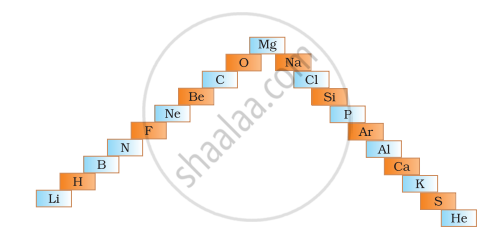
- Electropositive nature of the element(s) increases down the group and decreases across the period
- Electronegativity of the element decreases down the group and increases across the period
- Atomic size increases down the group and decreases across a period (left to right)
- Metallic character increases down the group and decreases across a period.
On the basis of the above trends of the Periodic Table, answer the following about the elements with atomic numbers 3 to 9.
- Name the most electropositive element among them
- Name the most electronegative element
- Name the element with smallest atomic size
- Name the element which is a metalloid
- Name the element which shows maximum valency.
Arrange the following in order of increasing radii:
Mg2+, Mg, Mg+
Explain your choice.
In Period 3 of the Periodic Table, element B is placed to the left of element A. On the basis of this information, choose the correct word from the option to complete the following statement:
The element A would have ______ atomic size than B.
Which one of the following has the largest atomic radius?
