Advertisements
Advertisements
प्रश्न
On an outline map of India, show the following.
- Areas receiving rainfall over 400 cm.
- Areas receiving less than 20 cm of rainfall.
- The direction of the south-west monsoon over India.
Advertisements
उत्तर
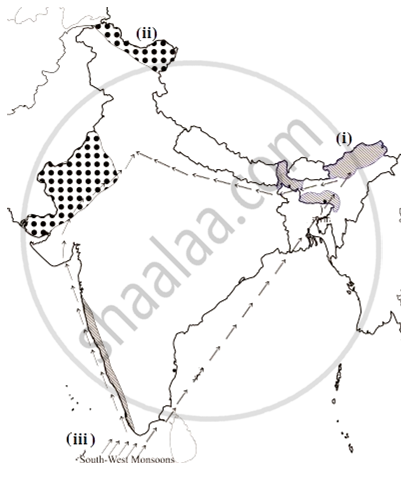
- The Western Coast and NorthEastern India receive rainfall over 400 cm. Mawsynram and Cherrapunji in Meghalaya are known for receiving maximum rainfall in the world. The Andaman Islands and Lakshadweep Islands are also known to receive annual rainfall above 400 cm.
- The parts of Northern Kashmir, Western Rajasthan, Deccan plateau, and Punjab are known to be the areas that receive scanty rainfall that is less than 20 cm. In the Northern part of India, rainfall decreases toward the west, while in the peninsular region except for Tamil Nadu, the rainfall decreases eastwards.
- South-west monsoon is a compound and a self-evolved weather system unique to the Indian subcontinent. The south west monsoon in India moves in south-west direction. In India, there are only south-west and north-east monsoons. Because of the Coriolis effect, the south-east monsoon becomes south-west trade winds.
संबंधित प्रश्न
Give reason as to why.
Seasonal reversal of wind direction takes place over the Indian subcontinent?
State whether right or wrong. Rewrite the wrong sentence.
India faces tropical cyclones frequently.
Give geographical reasons:
Convectional type of rainfall is not prominent in India.
There is a peculiar uniformity in the climate of India due to its unique ______.
Match the following.
| 1. | Rubber and Mahogany | Western Himalayas |
| 2. | Sandwood and rosewood | Eastern Himalayan Forest |
| 3. | Oak, birch, Silver | Coastal forest |
| 4. | Casurina, Palm and coconut | Deciduous forest |
| 5. | Sal, Semal, Jamun and Jujube | Evergreen forest |
Match the Column I with Column II.
| Column I | Column II | |
| A. | Western Disturbance | Driest place on Earth |
| B. | Norwesters | North East monson |
| C. | Burst of monsoon | Bihar- Assam |
| D. | Cyclonic Depression | Marine Biosphere Reserve |
| E. | Gulf of mannar | South west monsoon |
| F. | Atacama desert | Punjab - Haryana |
Which part of India experiences the highest range of temperature in a day?
Why does the coromandal coast face frequent cyclones?
Find out which songs, dances, festivals and special food preparations are associated with certain seasons in your region. Do they have some commonality with other regions of India?
Mark the following in the outline map of India supplied to you. Write the names. Give Index
- Sikkim
- Lakshadweep Island
- Chennai Port
- Mineral oil refineries in Assam-Digboi
- Any one southern state with high density of population
- Tropic of Cancer
