Advertisements
Advertisements
प्रश्न
Now think why Jodhpur has a hot desert type of climate?
In spite of these facts see carefully if there is strong evidence to conclude that the monsoons still provide a very strong framework lending overall climatic unity to the whole country.
Advertisements
उत्तर
Jodhpur lies in the north-western part of the country. The Great Indian Desert is located in this region. Due to the presence of sand, the region experiences high diurnal range of temperature. Hence, Jodhpur has a hot desert type of climate.
APPEARS IN
संबंधित प्रश्न
Give reason as to why.
The delta region of the eastern coast is frequently struck by cyclones.
State whether right or wrong. Rewrite the wrong sentence.
India faces tropical cyclones frequently.
Give geographical reasons:
Convectional type of rainfall is not prominent in India.
The variation on______elements give rise to variety of vegetation.
Match the Column I with Column II.
| Column I | Column II | |
| A. | Tropical evergreen forest | Sandal wood |
| B. | Tropical Deciduous forest | Oak, silver fir |
| C. | Alpine forest | Black buck |
| D. | Tidal forest | Casuarina |
| E. | Coastal forest | Mahogany |
| F. | State animal of Andhra Pradesh, Pujab and Haryana | Mangrove trees |
Which regions of India still has natural vegetation in real sense?
What is the effect of latitude on the climate of India?
Observe the following graph and answer the questions given below:
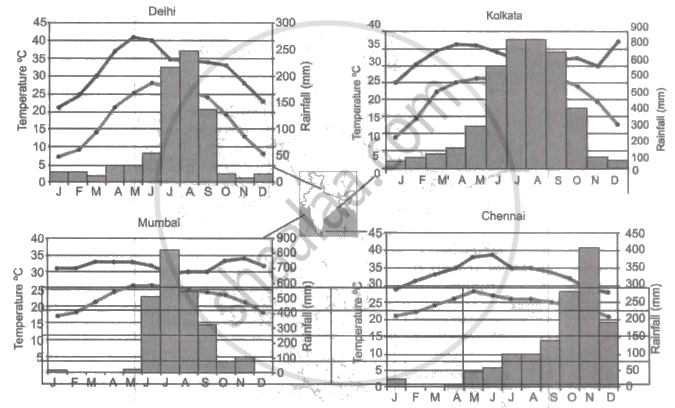
Note: In the graphs, the dark line represents the max. temperature and the lighter line represents min. temperature. The bars represent the amount of rainfall every month in each city.
- Where in the four cities is the rainfall heaviest?
- Which city has the most rainfall throughout the year?
- Which city experiences the highest temperature?
- Calculate the average range of minimum and maximum temperature for all four cities.
- What do the temperature curves in Delhi indicate?
- What is the condition of Mumbai during monsoons?
Why the houses in Rajasthan have thick walls and flat roofs?
Study the climatic data of station X and answer the following questions:
| Month | Jan | Feb | Mar | Apr | May | Jun | July | Aug | Sep | Oct | Nov | Dec |
| Temp (°C) | 23.1 | 24.8 | 26.5 | 29.3 | 32 | 32.8 | 33.1 | 32.1 | 30.5 | 29.3 | 28.7 | 26.1 |
| Rainfall (cm) | 7.3 | 1.1 | 0.3 | 0.1 | 1.3 | 4.5 | 6.1 | 8.2 | 8.5 | 20.1 | 20.8 | 9.0 |
- What is the annual range of temperature of station X?
- Which is the driest month?
- Name the wind that brings maximum rainfall to this station.
