Advertisements
Advertisements
प्रश्न
Now let us look at the uses of the word break. Match the word with its meanings below. Try to find out at least three other ways in which to use the word.
- The storm broke – could not speak; was too sad to speak
- Daybreak – this kind of weather ended
- His voice is beginning to break – it began or burst into activity
- Her voice broke and she cried – the beginning of daylight
- The heat wave broke – changing as he grows up
- Broke the bad news – end it by making the workers submit
- Break a strike – gently told someone the bad news
- (Find your own expression. Give its meaning here)
Advertisements
उत्तर
- The storm broke – this kind of weather ended
- Daybreak – the beginning of daylight
- His voice is beginning to break – changing as he grows up
- Her voice broke and she cried – could not speak, was too sad to speak
- The heat wave broke – it began or burst into activity
- Broke the bad news – gently told someone the bad news
- Break a strike – end it by making the workers submit
- Breakdown – a machine failure
संबंधित प्रश्न
Pick out word from the text that mean the same as the following word or expression. (Look in the paragraph indicated.)
the power to endure, without falling ill : _________
Discuss with your partner the similarities and differences between your dream houses.
When we write informal letters (to a friend, or to a member of our family), we use this layout.
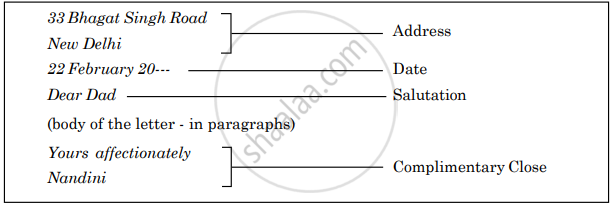
The next man looking 'cross the way
Saw one not of his church
And Couldn't bring himself to give
The fire his stick of birch.
The third one sat in tattered clothes.
He gave his coat a hitch.
Why should his log be put to use
To warm the idle rich?
The rich man just sat back and thought
of the wealth he had in store
And how to keep what he had earned
From the lazy shiftless poor.
Read the lines given above and answer the question that follow.
In stanza 3, why did the man refuse to use his stick of wood?
“There were three animals altogether,” he explained. “There were two goats and a cat and then there were four pairs of pigeons.”
“And you had to leave them?” I asked.
“Yes. Because of the artillery. The captain told me to go because of the artillery.” “And you have no family?” I asked, watching the far end of the bridge where a few last carts were hurrying down the slope of the bank.
“No,” he said, “only the animals I stated. The cat, of course, will be all right. A cat can look out for itself, but I cannot think what will become of the others.”
“What politics have you?” I asked.
“I am without politics,” he said. “I am seventy-six years old. I have come twelve kilometers now and I think now I can go no further.”
“This is not a good place to stop,” I said. “If you can make it, there are trucks up the road where it forks for Tortosa.”
“I will wait a while,” he said, “ and then I will go. Where do the trucks go?” “Towards Barcelona,” I told him.
“I know no one in that direction,” he said, “but thank you very much.
Read the extract given below and answer the question that follow.
Does the old man have a family? What were the animals he was worried about?
When there was a strong wind, the pine trees made sad, eerie sounds that kept most people to the main road. But Mr. Oliver was not a nervous or imaginative man. He carried a torch – and on the night I write of, its pale gleam, the batteries were running down – moved fitfully over the narrow forest path. When its flickering light fell on the figure of a boy, who was sitting alone on a rock, Mr. Oliver stopped.
Boys were not supposed to be out of school after seven P.M. and it was now well past nine. What are you doing out here, boy, asked Mr. Oliver sharply, moving closer so that he could recognize the miscreant.
Read the extract given below and answer the question that follow.
Whom did Mr Oliver meet in the forest?
What are the 'present wants'? Who is its need of I~ 'present wants'? Why?
"Here comes someone running". Who has been referred to in this sentence?
How did Mr Wonka collected all those ancient items?
Did she repent her hasty action? How does she show her repentance?
Which is the word in the extract that means ‘a liquid sweet juice?
What does a garden snake eat?
Read the newspaper report to find the following facts about Columbia’s ill-fated voyage.
Number of experiments done by scientists: ____________
Complete the following sentence.
When the boy started to bring him pieces of cake and biscuit, the squirrel _________
Multiple Choice Question:
Which of the following words means opposite to punished’?
Write True or False against the following statement.
Radha’s mother enjoys doing things with her.
Who is the speaker in the poem?
Add im- or in- to each of the following words and use them in place of the italicised words in the sentences given below.
| patient, proper, possible, sensitive, competent |
He lacks competence. That’s why he can’t keep any job for more than a year.
Which of the following lines contains the same literary device as the one in 'I wandered lonely as a cloud,' from wordsworth's poem, 'Daffodils'?
When Antony says, ‘This is a slight unmeritable man/Meet to be sent on errands’, he refers to ______.
