Advertisements
Advertisements
प्रश्न
The words helper, companion, partner and accomplice have very similar meanings, but each word is typically used in certain phrases. Can you fill in the blanks below with the most commonly used words? A dictionary may help you.
his …………….. in his criminal activities.
पर्याय
helper
companion
partner
accomplice
Advertisements
उत्तर
his accomplice in his criminal activities.
संबंधित प्रश्न
The Shehnai of Bismillah Khan Thinking about the text :
Tick the right answer.
Bismillah Khan’s first trip abroad was to (Afghanistan, U.S.A., Canada).
Answer of these question in a short paragraph (about 30 words).
What characteristics does he say he inherited from his parents?
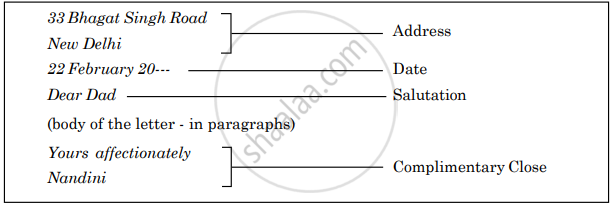
When we write informal letters (to a friend, or to a member of our family), we use this layout.
What does he plant who plants a tree? a
He plants a friend of sun and sky;b
He plants the flag of breezes free;
The shaft of beauty, towering high;
He plants a home to heaven anigh;
For song and mother-croon of bird
In hushed and happy twilight heard____
The treble of heaven's harmony_____
These things he plants who plants a tree.
Read the lines given above and answer the question that follow:
The black man's face bespoke revenge
As the fire passed from his sight.
For all he saw in his stick of wood
Was a chance to spite the white.
The last man of this forlorn group
Did nought except for gain.
Giving only to those who gave
Was how he played the game.
Their logs held tight in death's still hands
Was proof of human sin.
They didn't die from the cold without
They died from the cold within.
Read the lines given above and answer the question that follow.
What was the obvious cause of their deaths ?
Some are like fields of sunlit corn,
Meet for a bride on her bridal morn,
Some, like the flame of her marriage fire,
Or, rich with the hue of her heart's desire,
Tinkling,luminous,tender, and clear,
Like her bridal laughter and bridal tear.
Read the lines given above and answer the question that follow.
Explain with reference to context.
So please, oh please, we beg, we pray,
Go throw your TV set away,
And in its place you can install
A lovely bookshelf on the wall.
Then fill the shelves with lots of books,
Ignoring all the dirty looks,
The Screams and yells,the bites and kicks,
And children hitting you with sticks-
Fear not, because we promise you
That, in about a week ot two
Of having nothing else to do,
They'll now begin to feel the need
Of having something to read.
And once they start - oh boy, oh boy!
You watch the slowly growing joy
That fills their hearts. They'll grow so keen
They'll wonder what they'd ever seen
In that ridiculous machine,
That nauseating, foul, unclean,
Repulsive television screen!
And later, each and every kid
Will love you more for what you did.
Read the lines given above and answer the question given below.
Will the children appreciate this action of their parents?
We will ponder your proposition and when we decide we will let you know. But should we accept it, I here and now make this condition that we will not be denied the privilege without molestation of visiting at any time the tombs of our ancestors, friends, and children. Every part of this soil is sacred in the estimation of my people. Every hillside, every valley, every plain and grove, has been hallowed by some sad or happy event in days long vanished. Even the rocks, which seem to be dumb and dead as the swelter in the sun along the silent shore, thrill with memories of stirring events connected with the lives of my people, and the very dust upon which you now stand responds more lovingly to their footsteps than yours, because it is rich with the blood of our ancestors, and our bare feet are conscious of the sympathetic touch. Our departed braves, fond mothers, glad, happy hearted maidens, and even the little children who lived here and rejoiced here for a brief season, will love these somber solitudes and at eventide they greet shadowy returning spirits. And when the last Red Man shall have perished, and the memory of my tribe shall have become a myth among the White Men, these shores will swarm with the invisible dead of my tribe^ and when your children’s children think themselves alone in the field, the store, the shop, upon the highway, or in the silence of the pathless woods, they will not be alone. In all the earth there is no place dedicated to solitude. At night when the streets of your cities and villages are silent and you think them deserted, they will throng with the returning hosts’that once filled them and still lover this beautiful land. The White Man will never be alone.
Let him be just and deal kindly with my people, for the dead are not powerless. Dead, did I say? There is no death, only a change of worlds.
Read the extract given below and answer the question that follow.
When will the shores swarm with the invisible dead of the speaker’s tribe? Why?
After considering the matter, and talking it over with his wife, farmer Jones said that he would take John, and do well by him, now that his mother was out of the way; and Mrs. Ellis, who had been looking out for a bound girl, concluded that it would be charitable in her to make choice of Katy, even though she was too young to be of much use for several years.
“I could do much better, I know,” said Mrs. Ellis; “but as no one seems inclined to take her, I must act from a sense of duty expect to have trouble with the child; for she’s an undisciplined thing—used to having her own way.”
But no one said “I’ll take Maggie.” Pitying glances were cast on her wan and wasted form and thoughts were troubled on her account. Mothers brought cast-off garments and, removing her soiled and ragged clothes, dressed her in clean attire. The sad eyes and patient face of the little one touched many hearts, and even knocked at them for entrance. But none opened to take her in. Who wanted a bed-ridden child?
“Take her to the poorhouse,” said a rough man, of whom the question “What’s to be done with Maggie?” was asked. “Nobody’s going to be bothered with her.”
“The poorhouse is a sad place for a sick and helpless child,” answered one.
“For your child or mine,” said the other, lightly speaking; “but for tis brat it will prove a blessed change, she will be kept clean, have healthy food, and be doctored, which is more than can be said of her past condition.”
Read the extract given below and answer the question that follow.
Who came to mourn the dead woman? Why did no one follow the dead cart?
The women came out on the shore, and made for the stepping—?stones. They had plenty to laugh and bicker about, as they approached the river in a noisy crowd. They girded up their skirts, so as to jump from stone to stone, and they clanked their sickles and forks together over their shoulders to have ease of movement. They shouted their quarrels above the gush of the river. Noise frightens crocodiles. The big mugger did not move, and all the women crossed in safety to the other bank. Here they had to climb a steep hillside to get at the grass, but all fell to with a will, and sliced away at it wherever there was foothold to be had. Down below them ran the broad river, pouring powerfully out from its deep narrow pools among the cold cliffs and shadows, spreading into warm shallows, lit by kingfishers. Great turtles lived there, and mahseer weighing more than a hundred pounds. Crocodiles too. Sometimes you could see them lying out on those slabs of clay over there, but there were none to be seen at the moment.
Read the extract given below and answer the question that follow.
What were they doing on the hill?
Discuss the following topic in groups.
Do you think there is life on other planets? Can you guess what kind of people there may be on them? In what ways are they likely to be different from us?
Complete the following sentence by adding the appropriate part of the sentence given below.
Many wise men answered the king’s questions, _______________.
What sort of life did Dogs live a long time ago?
Read the newspaper report to find the following facts about Columbia’s ill-fated voyage.
Number of astronauts on board: ____________
Why do you think she/he has these worries? Can you think of ways to get rid of such worries?
The words given against the sentences below can be used both as nouns and verbs. Use them appropriately to fill in the blanks.
(i) The boys put up a good athletic____________________________ . (show)
(ii) The soldiers ________________________ great courage in saving people from floods.
Find out the meaning of the following words by looking them up in the dictionary. Then use them in sentences of your own.
smearing
What does the broken glass window suggest?
What did the dog do to lead the farmer to the hidden gold?
Fill in the blanks with the words given in the box.
| how, what, when, where, which |
There are so many toys in the shops. Neena can’t decide ______ one to buy.
