Advertisements
Advertisements
प्रश्न
Name the following:
The process by which wilting or drooping of leaves occurs.
Advertisements
उत्तर
Turgidity
संबंधित प्रश्न
Give scientific reasons : Balsam plants wilt during mid-day even if the soil is well watered.
Differentiate between the following:
Turgidity and Flaccidity
Give reason for the following:
A plant cell, when kept in a hypertonic salt solution for about 30 minutes, turns flaccid.
A leaf cell of a water plant was placed in a liquid other than pond water. After sometime, it assumed a shape as shown below:
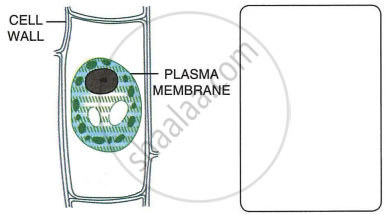
- Give the term for the state of the cell it has acquired.
- Name the structure which acts as a selectively permeable membrane.
- Comment on the nature (tonicity) of the liquid surrounding the cell.
- Name any one feature of this plant cell which is not present in an animal cell.
- Redraw in the space provided, the diagram of the cell if it is soon placed in ordinary water for some time.
Give Technical Term for the following.
A cell in a fully extended condition.
Give Technical Term for the following.
The pressure exerted by cell contents on a plant cell wall.
Excessive use of fertilisers in agricultural fields reduces the yield of crops. Justify the statement.
When the cells of a plant are fully distended, the condition is called ______.
Give the equivalent term for the following:
Pressure exerted by the cell contents on the cell wall.
