Advertisements
Advertisements
प्रश्न
Match the following :
| (a) Charan Singh | (i) Industrialization |
| (b) PC Mahalanobis | (ii) Zoning |
| (c) Bihar Famine | (iii) farmers |
| (d) Verghese Kurien | (iv) Milk Cooperatives |
Advertisements
उत्तर
| (a) Charan Singh | (iii) farmers |
| (b) PC Mahalanobis | (i) Industrialization |
| (c) Bihar Famine | (ii) Zoning |
| (d) Verghese Kurien | (iv) Milk Cooperatives |
APPEARS IN
संबंधित प्रश्न
Which of the following ideas did not form part of the early phase of India’s development policy ?
What were the major differences in the approach towards development at the time of Independence? Has the debate been resolved?
The Socialist model of development was related to ______.
Local Self Government intends to improve ______.
Number of part-time members in NITI Aayog is ______.
Engagement of local people in development project refers to ______.
Consider these statements about NITI Aayog. Find the Wrong statement.
Why was the Planning Commission replaced by NITI Aayog?
Study the picture given below and answer the question that follows:

Choose the first state to be created due to linguistic demands after independence:
Observe the figure below and answer accordingly.
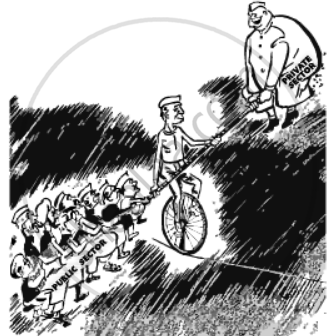
Who in the picture is balancing between the public and private sectors?
Observe the figure below and answer accordingly.
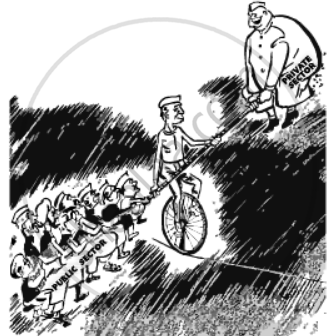
Why has a big tilt towards the public sector been shown in the cartoon?
Read the following paragraph and answer according.
NITI Aayog or National Institution for Transforming India Aayog is basically a policy think tank of Government of India and State Governments that replaces the 65-year old Planning Commission.
The Union Government of India had announced formation of NITI Aayog on 1st January, 2015. The body is composed of a CEO and a Vice Chairperson, to be appointed by the Prime Minister, in addition to some full-time members and two part-time members, while four Union Ministers would serve as ex-officio members.
Besides, there would be specific regional councils, while experts and specialists from various fields would be called as special invitees nominated by the Prime Ministers.
NITI Aayog will serve as a “think tank” of the government as a “directional and policy dynamo” and would provide both to the governments at the centre and in the states with strategic and technical advice on key policy matters including economic issues of national and international importance.
NITI Aayog will have regional councils to focus on developmental activities on specific areas and is patterned on the National Reforms Development Commission of China.
The CFO and Vice Chairperson of NITI Aayog is appointed by ______.
Which of the following ideas did not form part of the early phase of India's development policy?
Which of the following is not a feature of Indian economic planning?
"GRAND INNOVATION CHALLENGE" was launched by
What is Plan Holiday?
Which two model of development India had adopted on the eve of independence?
Why did India adopt planning?
When was Planning Commission set up in India by a simple resolution of the government of India?
Choose the correct statement.
- The Club of Rome published a book in 1972 entitled Limits to Growth.
- In 1987, Brundtland Report, our common futures was published.
- The Rio Summit produced conventions dealing with climate change, and biodiversity forestry and recommended a list of development called Agenda 21.
- Common but differentiated responsibilities were declared at the Earth Summit in 1992.
Who among the following appoints the Vice Chairperson of NITI Aayog?
Which factor was responsible for discouraging research and development in the manufacturing sector?
Which of the following statements about NITI Aayog are true?
- NITI Aayog acts as a “think tank” of the Union Government.
- NITI Aayog acts against terrorism.
- NITI Aayog acts in the spirit of cooperative federalism.
- NITI Aayog decides more roles for bigger states and smaller roles for smaller states.
Choose the correct option:
Planning Commission was set up by ______.
