Advertisements
Advertisements
प्रश्न
Who among the following appoints the Vice Chairperson of NITI Aayog?
पर्याय
President of India
Prime Minister of India
Vice President of India
Lok Sabha Speaker
Advertisements
उत्तर
Prime Minister of India
Explanation:
The Vice-Chairman of NITI Aayog is chosen by the Prime Minister.
APPEARS IN
संबंधित प्रश्न
Which of the following ideas did not form part of the early phase of India’s development policy ?
“Indian policy makers made a mistake by emphasising the role of state in the economy. India could have developed much better if private sector was allowed a free play right from the beginning”. Give arguments for or against this proposition.
Which of the following is not a contributory factor for development?
The Socialist model of development was related to ______.
Who among the following was the first chairman of Tripura State Planning Board?
Local Self Government intends to improve ______.
Who amongst the following is the longest serving member of Tripura State Planning Board?
The entire process of participatory development can be completed in ______.
The leader and the country that helped to reach the Tashkent agreement between India and Pakistan.
NITI Aayog serves as a think-tank to promote ______ federation where government acts as a ______ with the help of technology. Select the correct option.
Why was the Planning Commission replaced by NITI Aayog?
Study the picture given below and answer the question that follows:

Choose the first state to be created due to linguistic demands after independence:
Observe the figure below and answer accordingly.
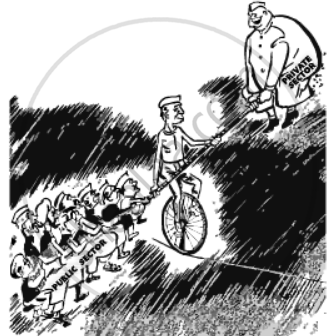
Why has a big tilt towards the public sector been shown in the cartoon?
Observe the figure below and answer accordingly.
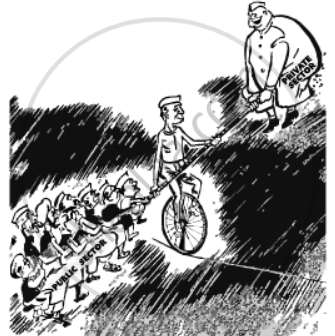
Which type of economic model was adopted by India?
The idea of planning in India was drawn from
- The Bombay plan
- Experiences of the Soviet bloc countries
- Gandhian vision of society
- Demand by peasant organisations
Planning Commission was scrapped on
Which of the following is not a feature of Indian economic planning?
Which of the following option is correct?
What is the meaning and importance of economic planning in the Indian context?
Why did India adopt planning?
When was Planning Commission set up in India by a simple resolution of the government of India?
Which of the following is/are correct about the Bombay plan?
Choose the correct statement.
- The Club of Rome published a book in 1972 entitled Limits to Growth.
- In 1987, Brundtland Report, our common futures was published.
- The Rio Summit produced conventions dealing with climate change, and biodiversity forestry and recommended a list of development called Agenda 21.
- Common but differentiated responsibilities were declared at the Earth Summit in 1992.
Which of the following statements about NITI Aayog are true?
- NITI Aayog acts as a think tank of the Union Government.
- NITI Aayog acts against terrorism.
- NITI Aayog acts in a spirit of cooperative federalism.
- NITI Aayog design strategic and long term policy and programme frameworks.
Which one of the following is not the objective of NITI Aayog?
