Advertisements
Advertisements
प्रश्न
Mark the correct options.
(a) An atom with a vacancy has smaller energy that a neutral atom.
(b) K X-ray is emitted when a hole makes a jump from the K shell to some other shell.
(c) The wavelength of K X-ray is smaller than the wavelength of L X-ray of the same material.
(d) The wavelength of Kα X-ray is smaller than the wavelength of Kβ X-ray of the same material.
Advertisements
उत्तर
(b) K X-ray is emitted when a hole makes a jump from the K shell to some other shell.
(c) The wavelength of K X-ray is smaller than the wavelength of L X-ray of the same material.
Energy of a vacant atom is higher than that of a neutral atom.
Hence, option (a) is incorrect.
K X-ray is emitted when an electron makes a jump to the K shell from some other shell. As a result, a positive charge hole is created in the outer shell. As the electron continuously moves to the K shell, the hole moves from the K shell to some other shell. Hence, option (b) is correct.
K X-ray is emitted due to the transition of an electron from the L or M shell to the K shell and L X-ray is emitted due to the transition of an electron from the M or N shell to the L shell. The energy involved in the transition from the L or M shell to the K shell is higher than the energy involved in the transition from the M or N shell to the L shell. Since the energy is inversely proportional to the wavelength, the wavelength of the K X-ray is smaller than the wavelength of the L X-ray of the same material. Hence, option (c) is correct.
If EK, EL and EM are the energies of K, L and M shells, respectively, then the wavelength of Kα X-ray (`lambda_1`) is given by
`lambda_1 = (hc)/(E_K - E_L)`
Here,
h = Planck's constant
c = Speed of light
Wavelength of the Kβ X-ray (`lambda_2`) is given by
`lambda_2 = (hc)/(E_K - E_M)`
As the difference of energies (`E_K - E_M`) is more than `(E_K - E_L)`, `λ_2` is less than `λ_1` Hence, option (d) is not correct.
APPEARS IN
संबंधित प्रश्न
What is the range of the wavelength of the following electromagnetic waves?
(a) Gamma rays.
State the approximate range of wavelength associated with infrared rays.
Give one use of gamma rays.
What are ultraviolet radiations?
The wavelength of X-rays is 0.01 Å. Calculate its frequency. State the assumption made, if any.
Can Lα X-ray of one material have shorter wavelength than Kα X-ray of another?
Heat at the rate of 200 W is produced in an X-ray tube operating at 20 kV. Find the current in the circuit. Assume that only a small fraction of the kinetic energy of electrons is converted into X-rays.
An X-ray tube operates at 40 kV. Suppose the electron converts 70% of its energy into a photon at each collision. Find the lowest there wavelengths emitted from the tube. Neglect the energy imparted to the atom with which the electron collides.
(Use Planck constant h = 6.63 × 10⁻³⁴ Js= 4.14 × 10⁻¹⁵ eVs, speed of light c = 3 × 10⁸ m/s.)
Write the range of the wavelength of the following electromagnetic radiations:
(a) Infrared rays
(b) Ultraviolet rays
(c) γ -rays
Write one use of each of the above.
Calculate the shortest wavelength of electromagnetic radiation present in Balmer series of hydrogen spectrum.
Identify the part of the electromagnetic spectrum used in
(i) radar and
(ii) eye surgery. Write their frequency range.
Name two sources of infrared radiation.
Give one use of electromagnetic radiation in Microwaves.
Name the radiations used for the detection of fracture in bones.
Choose the correct option.
The EM wave emitted by the Sun and responsible for heating the Earth’s atmosphere due to greenhouse effect is
The frequency of e. m waves which is best suited .to observed of radius 3 × 10⁻⁴ his of the order of
Why does microwave oven heats up a food item containing water molecules most efficiently?
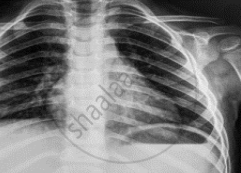
Name the electromagnetic radiation that has been used in obtaining the image below.