Advertisements
Advertisements
प्रश्न
Let A = {1, 2, 3, 4), B = {4, 5, 6}, C = {5, 6}. Verify, A × (B ∪ C) = (A × B) ∪ (A × C)
Advertisements
उत्तर
A = {1, 2, 3, 4} and
B ∪ C = {4, 5, 6} ∪ {5, 6}
= {4, 5, 6}
∴ A × (B ∪ C) = {(1, 4), (1, 5), (1, 6), (2, 4), (2, 5), (2, 6), (3, 4), (3, 5), (3, 6), (4, 4), (4, 5), (4, 6)} ...(1)
A = {1, 2, 3, 4}, B = {4, 5, 6}, C= {5, 6}
∴ A × B = {(1, 4), (1, 5), (1, 6), (2, 4), (2, 5), (2, 6), (3, 4), (3, 5), (3, 6), (4, 4), (4, 5), (4, 6)}
and A × C = {(1, 5), (1, 6), (2, 5), (2, 6), (3, 5), (3, 6), (4, 5), (4, 6)}
∴ (A × B) ∪ (A × C) = {(1, 4), (1, 5), (1, 6), (2, 4), (2, 5), (2, 6), (3, 4), (3, 5), (3, 6), (4, 4), (4, 5), (4, 6)} ...(2)
From (1) and (2), we get,
A × (B ∪ C) = (A × B) ∪ (A × C)
APPEARS IN
संबंधित प्रश्न
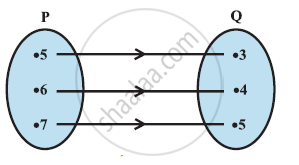
The given figure shows a relationship between the sets P and Q. Write this relation
- in set-builder form.
- in roster form.
What is its domain and range?
Let A = {x, y, z} and B = {1, 2}. Find the number of relations from A to B.
Let R be the relation on Z defined by R = {(a, b): a, b ∈ Z, a – b is an integer}. Find the domain and range of R.
Let A = {a, b}. List all relations on A and find their number.
If R is a relation defined on the set Z of integers by the rule (x, y) ∈ R ⇔ x2 + y2 = 9, then write domain of R.
If R = {(x, y) : x, y ∈ Z, x2 + y2 ≤ 4} is a relation defined on the set Z of integers, then write domain of R.
Let A = [1, 2, 3, 5], B = [4, 6, 9] and R be a relation from A to B defined by R = {(x, y) : x − yis odd}. Write R in roster form.
If A = {1, 2, 4}, B = {2, 4, 5}, C = {2, 5}, then (A − B) × (B − C) is
If R is a relation on the set A = [1, 2, 3, 4, 5, 6, 7, 8, 9] given by x R y ⇔ y = 3x, then R =
A relation R is defined from [2, 3, 4, 5] to [3, 6, 7, 10] by : x R y ⇔ x is relatively prime to y. Then, domain of R is
Let R be a relation from a set A to a set B, then
If R is a relation from a finite set A having m elements of a finite set B having n elements, then the number of relations from A to B is
Write the relation in the Roster Form. State its domain and range
R4 = {(x, y)/y > x + 1, x = 1, 2 and y = 2, 4, 6}
Write the relation in the Roster Form. State its domain and range
R6 = {(a, b)/a ∈ N, a < 6 and b = 4}
Identify which of if the following relations are reflexive, symmetric, and transitive.
| Relation | Reflexive | Symmetric | Transitive |
| R = {(a, b) : a, b ∈ Z, a – b is an integer} | |||
| R = {(a, b) : a, b ∈ N, a + b is even} | √ | √ | x |
| R = {(a, b) : a, b ∈ N, a divides b} | |||
| R = {(a, b) : a, b ∈ N, a2 – 4ab + 3b2 = 0} | |||
| R = {(a, b) : a is sister of b and a, b ∈ G = Set of girls} | |||
| R = {(a, b) : Line a is perpendicular to line b in a plane} | |||
| R = {(a, b) : a, b ∈ R, a < b} | |||
| R = {(a, b) : a, b ∈ R, a ≤ b3} |
Answer the following:
If A = {1, 2, 3}, B = {4, 5, 6} check if the following are relations from A to B. Also write its domain and range
R1 = {(1, 4), (1, 5), (1, 6)}
Answer the following:
If A = {1, 2, 3}, B = {4, 5, 6} check if the following are relations from A to B. Also write its domain and range
R3 = {(1, 4), (1, 5), (3, 6), (2, 6), (3, 4)}
Answer the following:
Find R : A → A when A = {1, 2, 3, 4} such that R = (a, b)/a − b = 10}
Answer the following:
R = {1, 2, 3} → {1, 2, 3} given by R = {(1, 1), (2, 2), (3, 3), (1, 2), (2, 3)} Check if R is transitive
Answer the following:
Show that the following is an equivalence relation
R in A = {x ∈ Z | 0 ≤ x ≤ 12} given by R = {(a, b)/|a − b| is a multiple of 4}
Let A = {1, 2, 3, 7} and B = {3, 0, –1, 7}, the following is relation from A to B?
R3 = {(2, –1), (7, 7), (1, 3)}
Let A = {1, 2, 3, 7} and B = {3, 0, –1, 7}, the following is relation from A to B?
R4 = {(7, –1), (0, 3), (3, 3), (0, 7)}
Let A = {9, 10, 11, 12, 13, 14, 15, 16, 17} and let f : A → N be defined by f(n) = the highest prime factor of n ∈ A. Write f as a set of ordered pairs and find the range of f
Let X = {a, b, c, d} and R = {(a, a), (b, b), (a, c)}. Write down the minimum number of ordered pairs to be included to R to make it transitive
Let X = {a, b, c, d} and R = {(a, a), (b, b), (a, c)}. Write down the minimum number of ordered pairs to be included to R to make it equivalence
In the set Z of integers, define mRn if m − n is divisible by 7. Prove that R is an equivalence relation
Choose the correct alternative:
The rule f(x) = x2 is a bijection if the domain and the co-domain are given by
Is the following relation a function? Justify your answer
R2 = {(x, |x |) | x is a real number}
If R3 = {(x, x) | x is a real number} is a relation. Then find domain and range of R3.
If R = {(x, y): x, y ∈ Z, x2 + 3y2 ≤ 8} is a relation on the set of integers Z, then the domain of R–1 is ______.
Let A = {1, 2, 3, 4}, B = {1, 5, 9, 11, 15, 16} and f = {(1, 5), (2, 9), (3, 1), (4, 5), (2, 11)}. Is the following true?
f is a function from A to B
Justify your answer in case.
For two non-empty sets \(A\) and \(B\), which expression gives their Cartesian product?
The Cartesian product \(A\times A\) has \(9\) elements and contains \((-1,0)\) and \((0,1)\). What is \(A\)?
