Advertisements
Advertisements
प्रश्न
Identify which of if the following relations are reflexive, symmetric, and transitive.
| Relation | Reflexive | Symmetric | Transitive |
| R = {(a, b) : a, b ∈ Z, a – b is an integer} | |||
| R = {(a, b) : a, b ∈ N, a + b is even} | √ | √ | x |
| R = {(a, b) : a, b ∈ N, a divides b} | |||
| R = {(a, b) : a, b ∈ N, a2 – 4ab + 3b2 = 0} | |||
| R = {(a, b) : a is sister of b and a, b ∈ G = Set of girls} | |||
| R = {(a, b) : Line a is perpendicular to line b in a plane} | |||
| R = {(a, b) : a, b ∈ R, a < b} | |||
| R = {(a, b) : a, b ∈ R, a ≤ b3} |
Advertisements
उत्तर
i. R = {(a, b)/a, b ∈ Z, a - b is an integer}
Let a, b, c ∈ Z
∵ a − a = 0 ∈ Z
∴ aRa ∀ a ∈ Z
∴ R is reflective
Let aRb ∴ a − b is an integer
∴ −(a − b) = b − a is also an integer
∴ bRa
∴ aRb ⇒ bRa ∀ a, b ∈ Z
∴ R is symmetric
Let aRb, bRc
∴ a − b, b − c are integers
∴ (a − b) + (b − c) = a − c is an integer
∴ aRb, bRc ⇒ aRc ∀ a, b, c ∈ Z
∴ R is transitive.
ii. R = {(a, b) / a, b ∈ N, a + b is even}
Let a, b, c ∈ N
a + a = 2a is even
∴ aRa ∀ a ∈ N
R is reflexive
Let aRb . ·. a + b is even
∴ b + a is even
∴ bRa
∴ aRb ⇒ bRa ∀ a, b ∈ N
∴ R is symmetric
Let aRb, bRc
∴ a + b, b + c are even
Let a + b = 2m, b + c = 2n
∴ (a + b) + (b + c) = 2m + 2n
∴ a + c = 2m + 2n -− 2b = 2 (m + n − b) is even
∴ aRc
∴ aRb, bRc ⇒ aRc ∀ a, b, c ∈ N
∴ R is transitive.
iii. R = {(a, b) / a, b ∈ N, a divides b}
∵ a divides a aRa ∀ a ∈ N
∵ R is reflexive
Let a = 2, b = 4
∴ 2 divides 4 so that aRb
But 4 does not divide 2 ∴ `bcancelRa`
∴ aRb `cancel=> bRc`
∴ R is not symmetric
Let aRb, bRc
∴ a divides b, b divides c
∴ b = am, c = bn, m, n ∈ N
∴ c = bn = (am)n = a(mn)
∴ a divides c ∴ aRc
∴ aRb, bRc ⇒ aRc ∀ a, b, c ∈ N
∴ R is transitive.
iv. R = {(a, b) / a, b ∈ N, a2 − 4ab + 3b2 = 0}
aRb if a2 − 4ab + 3b2 = 0
i.e., if (a − b)(a − 3b) = 0
i.e., if a = b or a = 3b
a = a ∴ aRa ∀ a ∈ N
R is reflexive
Let a = 27, b = 9
∴ a = 3b ∴ aRb
`b cancel=a and b cancel= 3a`
`b cancelRa`
`bRb cancel=> bRa`
R is not symmetric
Let a = 27, b = 9, c = 3
a = 3b ∴ aRb
Also, b = 3c ∴ bRc
But `a cancel= c and a cancel= 3c`
`a cancelR c`
`aRb, bRc cancel=> aRc`
R is not transitive.
v. R = {(a, b) / a is a sister of b,
a, b ∈ G = Set of girls}
No girl is her own sister
`a cancelR a` for any a ∈ G
R is not reflexive
Let aRb
a is a sister of b
b is a sister of a
bRa
aRb ⇒ bRa ∀ a, b ∈ G
R is symmetric
Let aRb, bRc
a is a sister of b and b is a sister of c
aRc
aRb, bRc ⇒ aRc ∀ a, b, c ∈ G
R is transitive.
vi. R = {(a, b) / Line a is perpendicular to line b in a plane}
No line is perpendicular to itself
`a cancelR a` for any line
R is not reflexive
Let aRb
a is perpendicular to b
b is perpendicular to a
bRa
aRb ⇒ bRa ∀ a, b
R is symmetric
If a is perpendicular to b and b is perpendicular to c, then a is parallel to c
aRb, bRc `cancel=>` aRc
R is not transitive.
vii. R = {(a, b) / a, be R, a < b}
a ≮ a ∀ a ∈ R
R is not reflexive
Let a = 2, b = 4
a< b
aRb
But b ≮ a
b `cancelR` a
`aRb cancel=> bRa`
R is not symmetric
Let aRb, bRc
a < b, b < c
a < b < c i.e., a < c
aRc
aRb, bRc ⇒ aRc ∀ a, b, c ∈ R
R is transitive.
viii. R = {(a, b) / a, b ∈ R, a ≤ b3 }
Let a = −2
a3 = −8
But −2 > −8
`a cancel≤ a^3` for all a ∈ R
R is not reflexive
Let a = 1, b = 2 so that a3 = 1, b3 = 8
a < b3 ...aRb
But b > a3 `bcancelRa`
aRb ~ bRa
R is not symmetric
Let a = 8, b = 2, c = 1.5
a = b3 ...aRb
c3 = (1.5)3 = 3.375
b < c3
bRc
But a < c3
aRb, bRc `cancel=>` aRc
R is not transitive.
| Relation | Reflexive | Symmetric | Transitive |
| R = {(a, b) : a, b ∈ Z, a – b is an integer} | √ | √ | √ |
| R = {(a, b) : a, b ∈ N, a + b is even} | √ | √ | √ |
| R = {(a, b) : a, b ∈ N, a divides b} | √ | x | √ |
| R = {(a, b) : a, b ∈ N, a2 – 4ab + 3b2 = 0} | √ | x | x |
| R = {(a, b) : a is sister of b and a, b ∈ G = Set of girls} | x | √ | √ |
| R = {(a, b) : Line a is perpendicular to line b in a plane} | x | √ | x |
| R = {(a, b) : a, b ∈ R, a < b} | x | x | √ |
| R = {(a, b) : a, b ∈ R, a ≤ b3} | x | x | √ |
APPEARS IN
संबंधित प्रश्न
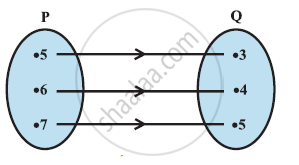
The given figure shows a relationship between the sets P and Q. Write this relation
- in set-builder form.
- in roster form.
What is its domain and range?
Let R be the relation on Z defined by R = {(a, b): a, b ∈ Z, a – b is an integer}. Find the domain and range of R.
The relation f is defined by f(x) = `{(x^2,0<=x<=3),(3x,3<=x<=10):}`
The relation g is defined by g(x) = `{(x^2, 0 <= x <= 2),(3x,2<= x <= 10):}`
Show that f is a function and g is not a function.
If A = [1, 2, 3], B = [4, 5, 6], which of the following are relations from A to B? Give reasons in support of your answer.
(i) [(1, 6), (3, 4), (5, 2)]
(ii) [(1, 5), (2, 6), (3, 4), (3, 6)]
(iii) [(4, 2), (4, 3), (5, 1)]
(iv) A × B.
Find the inverse relation R−1 in each of the cases:
(iii) R is a relation from {11, 12, 13} to (8, 10, 12] defined by y = x − 3.
Determine the domain and range of the relation R defined by
(ii) R = {(x, x3) : x is a prime number less than 10}
Let A = (x, y, z) and B = (a, b). Find the total number of relations from A into B.
Let R be a relation from N to N defined by R = {(a, b) : a, b ∈ N and a = b2}. Is the statement true?
(a, b) ∈ R and (b, c) ∈ R implies (a, c) ∈ R
Justify your answer in case.
Define a relation R on the set N of natural number by R = {(x, y) : y = x + 5, x is a natural number less than 4, x, y ∈ N}. Depict this relationship using (i) roster form (ii) an arrow diagram. Write down the domain and range or R.
If n(A) = 3, n(B) = 4, then write n(A × A × B).
If R is a relation on the set A = [1, 2, 3, 4, 5, 6, 7, 8, 9] given by x R y ⇔ y = 3x, then R =
Let R be a relation on N defined by x + 2y = 8. The domain of R is
If the set A has p elements, B has q elements, then the number of elements in A × B is
If R is a relation from a finite set A having m elements of a finite set B having n elements, then the number of relations from A to B is
If (x − 1, y + 4) = (1, 2) find the values of x and y
Let A = {1, 2, 3, 4), B = {4, 5, 6}, C = {5, 6}. Verify, A × (B ∪ C) = (A × B) ∪ (A × C)
Write the relation in the Roster Form. State its domain and range
R5 = {(x, y)/x + y = 3, x, y∈ {0, 1, 2, 3}
Write the relation in the Roster Form. State its domain and range
R7 = {(a, b)/a, b ∈ N, a + b = 6}
Select the correct answer from given alternative.
Let R be a relation on the set N be defined by {(x, y)/x, y ∈ N, 2x + y = 41} Then R is ______.
Select the correct answer from given alternative
If A = {a, b, c} The total no. of distinct relations in A × A is
Answer the following:
If A = {1, 2, 3}, B = {4, 5, 6} check if the following are relations from A to B. Also write its domain and range
R4 = {(4, 2), (2, 6), (5, 1), (2, 4)}
Let A = {1, 2, 3, 4, …, 45} and R be the relation defined as “is square of ” on A. Write R as a subset of A × A. Also, find the domain and range of R
Multiple Choice Question :
If there are 1024 relation from a set A = {1, 2, 3, 4, 5} to a set B, then the number of elements in B is
Let X = {a, b, c, d} and R = {(a, a), (b, b), (a, c)}. Write down the minimum number of ordered pairs to be included to R to make it symmetric
Let A = {a, b, c} and R = {(a, a), (b, b), (a, c)}. Write down the minimum number of ordered pairs to be included to R to make it transitive
On the set of natural numbers let R be the relation defined by aRb if a + b ≤ 6. Write down the relation by listing all the pairs. Check whether it is reflexive
In the set Z of integers, define mRn if m − n is divisible by 7. Prove that R is an equivalence relation
Choose the correct alternative:
Let R be the universal relation on a set X with more than one element. Then R is
If R2 = {(x, y) | x and y are integers and x2 + y2 = 64} is a relation. Then find R2.
Is the given relation a function? Give reasons for your answer.
g = `"n", 1/"n" |"n"` is a positive integer
If R = {(x, y): x, y ∈ Z, x2 + 3y2 ≤ 8} is a relation on the set of integers Z, then the domain of R–1 is ______.
Let S = {x ∈ R : x ≥ 0 and `2|sqrt(x) - 3| + sqrt(x)(sqrt(x) - 6) + 6 = 0}`. Then S ______.
Which statement is true in general for ordered pairs?
Let \(A=\{1,2,3\}\), \(B=\{3,4\}\), and \(C=\{4,5,6\}\). What is \((A\times B)\cap(A\times C)\)?
