Advertisements
Advertisements
प्रश्न
“Indian policy makers made a mistake by emphasising the role of state in the economy. India could have developed much better if private sector was allowed a free play right from the beginning”. Give arguments for or against this proposition.
Advertisements
उत्तर
No, the above statement is not perfectly true because state’s intervention was mandatory to regulate country’s economy
after independence immediately. Indian did not follow either capitalist model of development or socialist model completely. Instead she adopted the model of‘mixed economy’ to be criticised from the right and the left:
(i) Private sector lacked enough space and stimulus to grow.
(ii) Licensing and permits for investment in private sector created hurdles for private capital accumulation.
(iii) The state control beyond the limits led to inefficiency and corruption.
State control was emphasised :-
1. State helped the private sector to make profits by intervening only in those areas where the private sector was not prepared to go.
2. Instead of helping the poor, the states intervention ended up creating a new class that enjoyed the privileges of higher salaries without much account-ability.
संबंधित प्रश्न
What were the major differences in the approach towards development at the time of Independence? Has the debate been resolved?
Tribals of Odisha fear their displacement due to the extraction of which mineral?
NITI AYOG was established on ______.
Who appoints the Vice-Chairperson of NITI Aayog?
Number of part-time members in NITI Aayog is ______.
Which state was carved out of Assam from the following?
______ Policy has been adopted by NITI Aayog.
NITI Aayog serves as a think-tank to promote ______ federation where government acts as a ______ with the help of technology. Select the correct option.
Why was the Planning Commission replaced by NITI Aayog?
During the Nehru era, why did some political parties and groups in our country believe that India should be more friendly with the bloc led by the US?
Observe the figure below and answer accordingly.
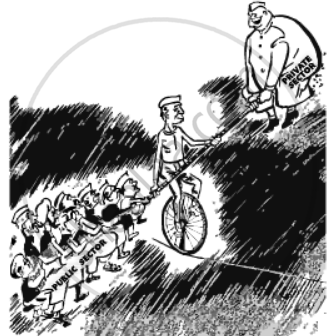
Why has a big tilt towards the public sector been shown in the cartoon?
Observe the figure below and answer accordingly.
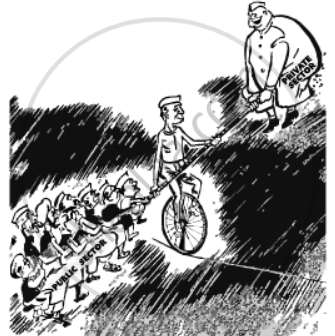
Which type of economic model was adopted by India?
Read the following paragraph and answer according.
NITI Aayog or National Institution for Transforming India Aayog is basically a policy think tank of Government of India and State Governments that replaces the 65-year old Planning Commission.
The Union Government of India had announced formation of NITI Aayog on 1st January, 2015. The body is composed of a CEO and a Vice Chairperson, to be appointed by the Prime Minister, in addition to some full-time members and two part-time members, while four Union Ministers would serve as ex-officio members.
Besides, there would be specific regional councils, while experts and specialists from various fields would be called as special invitees nominated by the Prime Ministers.
NITI Aayog will serve as a “think tank” of the government as a “directional and policy dynamo” and would provide both to the governments at the centre and in the states with strategic and technical advice on key policy matters including economic issues of national and international importance.
NITI Aayog will have regional councils to focus on developmental activities on specific areas and is patterned on the National Reforms Development Commission of China.
When was NITI Aayog formed?
Read the following paragraph and answer according.
NITI Aayog or National Institution for Transforming India Aayog is basically a policy think tank of Government of India and State Governments that replaces the 65-year old Planning Commission.
The Union Government of India had announced formation of NITI Aayog on 1st January, 2015. The body is composed of a CEO and a Vice Chairperson, to be appointed by the Prime Minister, in addition to some full-time members and two part-time members, while four Union Ministers would serve as ex-officio members.
Besides, there would be specific regional councils, while experts and specialists from various fields would be called as special invitees nominated by the Prime Ministers.
NITI Aayog will serve as a “think tank” of the government as a “directional and policy dynamo” and would provide both to the governments at the centre and in the states with strategic and technical advice on key policy matters including economic issues of national and international importance.
NITI Aayog will have regional councils to focus on developmental activities on specific areas and is patterned on the National Reforms Development Commission of China.
The CFO and Vice Chairperson of NITI Aayog is appointed by ______.
Which of these statements about the Bombay Plan is incorrect?
Which of the following is not a feature of Indian economic planning?
What is Plan Holiday?
Why did India adopt planning?
When was Planning Commission set up in India by a simple resolution of the government of India?
Which of the following is/are correct about the Bombay plan?
In which year was the NITI Aayog constituted?
When was NITI Aayog constituted?
Which of the following facts is/are incorrect about National Development Council?
Which of the following statements about NITI Aayog are true?
- NITI Aayog acts as a think tank of the Union Government.
- NITI Aayog acts against terrorism.
- NITI Aayog acts in a spirit of cooperative federalism.
- NITI Aayog design strategic and long term policy and programme frameworks.
The idea of planning in India was drawn from
- The Bombay Plan
- Experiences of the Soviet Bloc countries
- Gandhian vision of Society
- Demand by Peasant organizations
Which of the following statements about NITI Aayog are true?
- NITI Aayog acts as a “think tank” of the Union Government.
- NITI Aayog acts against terrorism.
- NITI Aayog acts in the spirit of cooperative federalism.
- NITI Aayog decides more roles for bigger states and smaller roles for smaller states.
Choose the correct option:
