Advertisements
Advertisements
प्रश्न
Which of these statements about the Bombay Plan is incorrect?
पर्याय
It was a blueprint for India's economic future.
It supported state ownership of industry.
It was made by some leading industrialists.
It supported strongly the idea of planning.
Advertisements
उत्तर
It supported state ownership of industry.
Explanation:
The Bombay Plan is the term given to a group of ideas made during World War II for the development of India's post-independence economy. The Bombay Plan" was the name given to a 15-year economic plan for India proposed in January 1944 by a group of entrepreneurs and technocrats. Initially, it was exclusively available for private distribution. In response to the interest produced by the idea, it was soon published as a pamphlet.
संबंधित प्रश्न
Match the following :
| (a) Charan Singh | (i) Industrialization |
| (b) PC Mahalanobis | (ii) Zoning |
| (c) Bihar Famine | (iii) farmers |
| (d) Verghese Kurien | (iv) Milk Cooperatives |
Tribals of Odisha fear their displacement due to the extraction of which mineral?
NITI AYOG was established on ______.
Planning Commission was scrapped on ______.
Tripura State Planning Board was set up in ______.
Number of part-time members in NITI Aayog is ______.
Who amongst the following is the longest serving member of Tripura State Planning Board?
The form of Participation where the primary stakeholders participate in the discussion and analysis of pre-determined objectives is called ______.
Which state was carved out of Assam from the following?
The leader and the country that helped to reach the Tashkent agreement between India and Pakistan.
Consider these statements about NITI Aayog. Find the Wrong statement.
Study the picture given below and answer the question that follows:

Choose the first state to be created due to linguistic demands after independence:
Observe the figure below and answer accordingly.
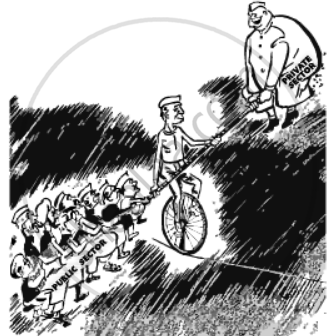
Who in the picture is balancing between the public and private sectors?
Observe the figure below and answer accordingly.
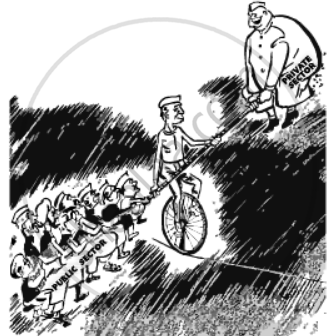
Why has a big tilt towards the public sector been shown in the cartoon?
The Planning Commission was established in the year
Following are a few points given on the approach towards development at the time of Independence. Which of them is correct?
- The common perception of Development was becoming modernized which involved the breakdown of traditional social structure
- After independence India had two models of development one was Europe's and US's liberal capital model and the other USSR's socialist model.
- Many including the Communist Party of India and leaders like Nehru. were impressed by the Soviet model and very few favored the American models.
"GRAND INNOVATION CHALLENGE" was launched by
Which of the following option is true in the context of the "Kerala Model"?
Choose the correct statement.
- The Club of Rome published a book in 1972 entitled Limits to Growth.
- In 1987, Brundtland Report, our common futures was published.
- The Rio Summit produced conventions dealing with climate change, and biodiversity forestry and recommended a list of development called Agenda 21.
- Common but differentiated responsibilities were declared at the Earth Summit in 1992.
Which factor was responsible for discouraging research and development in the manufacturing sector?
The idea of planning in India was drawn from
- The Bombay Plan
- Experiences of the Soviet Bloc countries
- Gandhian vision of Society
- Demand by Peasant organizations
Which one of the following is not the objective of NITI Aayog?
