Advertisements
Advertisements
प्रश्न
In two congruent triangles ABC and DEF, if AB = DE and BC = EF. Name the pairs of equal angles.
Advertisements
उत्तर
It is given that
ΔABC ≅ ΔDEF
AB = DE
BC = EF
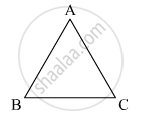
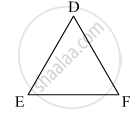
Since, the triangles ABC and DEF are congruent, therefore,
∠A = ∠D
∠B = ∠E
∠C = ∠F
APPEARS IN
संबंधित प्रश्न
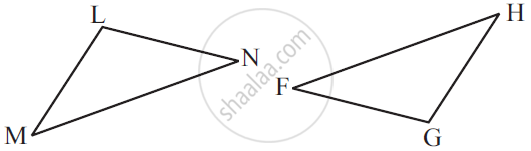
Which congruence criterion do you use in the following?
Given: ∠MLN = ∠FGH
∠NML = ∠GFH
ML = FG
So, ΔLMN ≅ ΔGFH
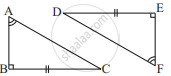
Explain, why ΔABC ≅ ΔFED.
Prove that the perimeter of a triangle is greater than the sum of its altitudes.
If ABC and DEF are two triangles such that AC = 2.5 cm, BC = 5 cm, ∠C = 75°, DE = 2.5 cm, DF = 5cm and ∠D = 75°. Are two triangles congruent?
The following figure shows a circle with center O.
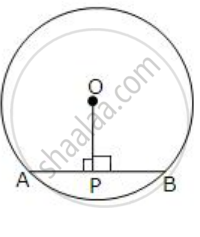
If OP is perpendicular to AB, prove that AP = BP.
From the given diagram, in which ABCD is a parallelogram, ABL is a line segment and E is mid-point of BC.
Prove that: AB = BL.
ABCD is a parallelogram. The sides AB and AD are produced to E and F respectively, such produced to E and F respectively, such that AB = BE and AD = DF.
Prove that: ΔBEC ≅ ΔDCF.
In the parallelogram ABCD, the angles A and C are obtuse. Points X and Y are taken on the diagonal BD such that the angles XAD and YCB are right angles.
Prove that: XA = YC.
In the following figure, OA = OC and AB = BC.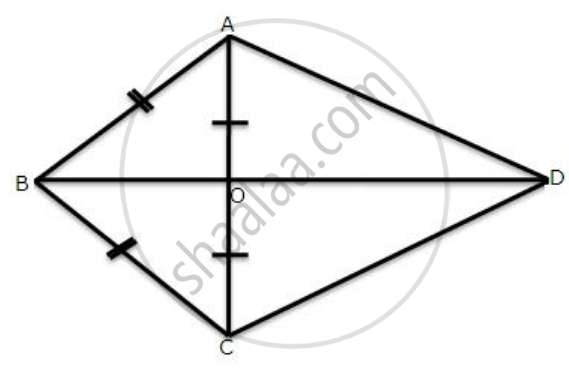
Prove that: ΔAOD≅ ΔCOD
In a triangle, ABC, AB = BC, AD is perpendicular to side BC and CE is perpendicular to side AB.
Prove that: AD = CE.
