Advertisements
Advertisements
प्रश्न
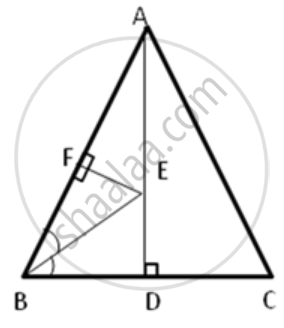
In the following figure, AB = AC and AD is perpendicular to BC. BE bisects angle B and EF is perpendicular to AB.
Prove that : ED = EF
Advertisements
उत्तर
In ΔEFB and ΔEDB,
∠EFB = ∠EDB ( both are 900 )
EB = EB ( common side )
∠FBE = ∠DBE ( given )
ΔEFB ≅ ΔEDB (AAS congruence criterion)
⇒ EF = ED (cpct )
that is , Ed = EF.
APPEARS IN
संबंधित प्रश्न
l and m are two parallel lines intersected by another pair of parallel lines p and q (see the given figure). Show that ΔABC ≅ ΔCDA.

Which congruence criterion do you use in the following?
Given: EB = DB
AE = BC
∠A = ∠C = 90°
So, ΔABE ≅ ΔCDB

In the figure, the two triangles are congruent.
The corresponding parts are marked. We can write ΔRAT ≅ ?

Explain, why ΔABC ≅ ΔFED.

If perpendiculars from any point within an angle on its arms are congruent, prove that it lies on the bisector of that angle.
In the given figure, prove that:
CD + DA + AB + BC > 2AC

From the given diagram, in which ABCD is a parallelogram, ABL is a line segment and E is mid-point of BC.
Prove that:
(i) ΔDCE ≅ ΔLBE
(ii) AB = BL.
(iii) AL = 2DC
From the given diagram, in which ABCD is a parallelogram, ABL is a line segment and E is mid-point of BC.
prove that : AL = 2DC
In the following figure, ∠A = ∠C and AB = BC.
Prove that ΔABD ≅ ΔCBE. 
In the following figure, ABC is an equilateral triangle in which QP is parallel to AC. Side AC is produced up to point R so that CR = BP.
Prove that QR bisects PC.
Hint: ( Show that ∆ QBP is equilateral
⇒ BP = PQ, but BP = CR
⇒ PQ = CR ⇒ ∆ QPM ≅ ∆ RCM ).
