Advertisements
Advertisements
प्रश्न
In the arrangement shown in the figure, y = 1.0 mm, d = 0.24 mm and D = 1.2 m. The work function of the material of the emitter is 2.2 eV. Find the stopping potential V needed to stop the photocurrent.
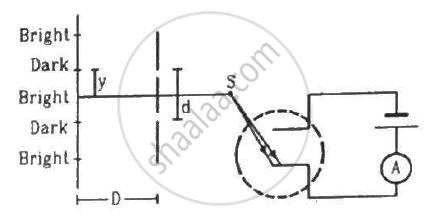
(Use h = 6.63 × 10⁻³⁴J-s = 4.14 × 10⁻¹⁵ eV-s, c = 3 × 10⁸ m/s and me = 9.1 × 10⁻³¹kg)
Advertisements
उत्तर
Given :-
Fringe width, y = 1 mm `xx` 2 = 2 mm
Work function, W0 = 2.2 eV
D = 1.2 m
d = 0.24 mm
Fringe width,
`y = (lambdaD)/d`,
where `lambda` = wavelength of light
`therefore lambda = (2 xx 10^-3 xx 0.24 xx 10^-3)/1.2`
`= 4 xx 10^-7 "m"`
Energy , `E = (hc)/lambda`
`= (4.14 xx 10^-15 xx 3 xx 10^8)/(4 xx 10^-7)`
= 3.105 `"eV"`
From Einstein's photoelectric equation,
`eV_0 = E - W_0`
where V0 is the stopping potential and e is charge of electron .
`therefore eV_0 = 3.105 - 2.2 = 0.905 "eV"`
`V_0 = 0.905/(1.6 xx 10^-19) xx 1.6 xx 10^-19 V`
= 0.905 V
APPEARS IN
संबंधित प्रश्न
The threshold frequency for a certain metal is 3.3 × 10¹⁴ Hz. If light of frequency 8.2 × 10¹⁴ Hz is incident on the metal, predict the cut-off voltage for the photoelectric emission.
Light of frequency 7.21 × 10¹⁴ Hz is incident on a metal surface. Electrons with a maximum speed of 6.0 × 10⁵ m/s are ejected from the surface. What is the threshold frequency for photoemission of electrons?
Is the formula you employ in (a) valid for calculating radius of the path of a 20 MeV electron beam? If not, in what way is it modified?
An electron gun with its collector at a potential of 100 V fires out electrons in a spherical bulb containing hydrogen gas at low pressure (∼10−2 mm of Hg). A magnetic field of 2.83 × 10⁻⁴ T curves the path of the electrons in a circular orbit of radius 12.0 cm. (The path can be viewed because the gas ions in the path focus the beam by attracting electrons, and emitting light by electron capture; this method is known as the ‘fine beam tube’ method. Determine e/m from the data.
What is so special about the combination e/m? Why do we not simply talk of e and m separately?
Visible light has wavelengths in the range of 400 nm to 780 nm. Calculate the range of energy of the photons of visible light.
(Use h = 6.63 × 10⁻³⁴J-s = 4.14 × 10⁻¹⁵ eV-s, c = 3 × 10⁸ m/s and me = 9.1 × 10⁻³¹kg)
Two neutral particles are kept 1 m apart. Suppose by some mechanism some charge is transferred from one particle to the other and the electric potential energy lost is completely converted into a photon. Calculate the longest and the next smaller wavelength of the photon possible.
(Use h = 6.63 × 10⁻³⁴J-s = 4.14 × 10⁻¹⁵ eV-s, c = 3 × 10⁸ m/s and me = 9.1 × 10⁻³¹kg)
A light beam of wavelength 400 nm is incident on a metal plate of work function 2.2 eV. (a) A particular electron absorbs a photon and makes two collisions before coming out of the metal. Assuming that 10% of the extra energy is lost to the metal in each collision, find the kinetic energy of this electron as it comes out of the metal. (b) Under the same assumptions, find the maximum number of collisions the electron can suffer before it becomes unable to come out of the metal.
In an experiment on photoelectric effect, the emitter and the collector plates are placed at a separation of 10 cm and are connected through an ammeter without any cell. A magnetic field B exists parallel to the plates. The work function of the emitter is 2.39 eV and the light incident on it has wavelengths between 400 nm and 600 nm. Find the minimum value of B for which the current registered by the ammeter is zero. Neglect any effect of space charge.
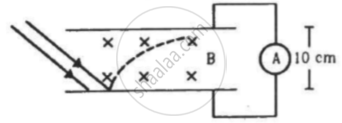
Work function of aluminium is 4.2 eV. If two photons each of energy 2.5 eV are incident on its surface, will the emission of electrons take place? Justify your answer.
In various experiments on photo electricity, the stopping potential for a given frequency of the incident radiation is ______.
The electromagnetic theory of light failed to explain ______.
Cathode rays can be deflected by
According to the wave picture, what is light?
What do free electrons at the surface of a metal do when radiation falls on the surface, according to the wave picture?
What does greater radiation intensity mean for the electric and magnetic fields in wave theory?
In the wave picture, how does absorption of energy by an electron take place over the radiation?
What energy must an electron gain to escape from the metal?
Which observation cannot be explained by the wave picture of continuous energy absorption?
