Advertisements
Advertisements
प्रश्न
What is so special about the combination e/m? Why do we not simply talk of e and m separately?
Advertisements
उत्तर
The basic relations for electric field and magnetic field are `("eV" = 1/2 "mv"^2)` and `("eBv" = ("mv"^2)/"r")` respectively
These relations include e (electric charge), v (velocity), m (mass), V (potential), r(radius), and B (magnetic field). These relations give the value of velocity of an electron as `["v" = sqrt(2"V"("e"/"m"))]` and `["v" = "Br"("e"/"m")]` respectively.
It can be observed from these relations that the dynamics of an electron are determined not by e and m separately, but by the ratio e/m.
APPEARS IN
संबंधित प्रश्न
The threshold frequency for a certain metal is 3.3 × 10¹⁴ Hz. If light of frequency 8.2 × 10¹⁴ Hz is incident on the metal, predict the cut-off voltage for the photoelectric emission.
(a) A monoenergetic electron beam with electron speed of 5.20 × 10⁶ m s−1 is subject to a magnetic field of 1.30 × 10⁻⁴ T normal to the beam velocity. What is the a radius of the circle traced by the beam, given e/m for electron equals 1.76 × 10¹¹ C kg−1?
(b) Is the formula you employ in (a) valid for calculating the radius of the path of a 20 MeV electron beam? If not, in what way is it modified?
If light of wavelength 412.5 nm is incident on each of the metals given below, which ones will show photoelectric emission and why?
| Metal | Work Function (eV) |
| Na | 1.92 |
| K | 2.15 |
| Ca | 3.20 |
| Mo | 4.17 |
Visible light has wavelengths in the range of 400 nm to 780 nm. Calculate the range of energy of the photons of visible light.
(Use h = 6.63 × 10⁻³⁴J-s = 4.14 × 10⁻¹⁵ eV-s, c = 3 × 10⁸ m/s and me = 9.1 × 10⁻³¹kg)
A horizontal cesium plate (φ = 1.9 eV) is moved vertically downward at a constant speed v in a room full of radiation of wavelength 250 nm and above. What should be the minimum value of v so that the vertically-upward component of velocity is non-positive for each photoelectron?
(Use h = 6.63 × 10⁻³⁴J-s = 4.14 × 10⁻¹⁵ eV-s, c = 3 × 10⁸ m/s and me = 9.1 × 10⁻³¹kg)
Work function of aluminium is 4.2 eV. If two photons each of energy 2.5 eV are incident on its surface, will the emission of electrons take place? Justify your answer.
For a given frequency of light and a positive plate potential in the set up below, If the intensity of light is increased then ______.
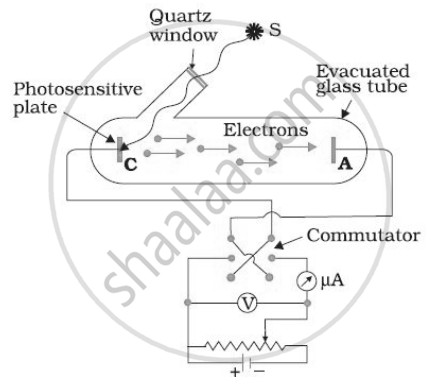
When a beam of 10.6 eV photons of intensity 2.0 W/m2 falls on a platinum surface of area 1.0 × 10⁻⁴ m2, only 53% of the incident photons eject photoelectrons. The number of photoelectrons emitted per second is ______.
Cathode rays can be deflected by
In photoelectric effect, the photoelectric current
An increase in the intensity of the radiation causing photo-electric emission from a surface does not affect the maximum K.E. of the photoelectrons. Explain.
Which phenomena were explained in a natural and satisfactory way by the wave picture of light?
According to wave theory, how should greater radiation intensity affect the energy absorbed by each electron?
Which wave-theory prediction about maximum kinetic energy contradicts the observed features of photoelectric emission?
Why does the energy absorbed by each electron per unit time become very small in the wave picture?
What energy must an electron gain to escape from the metal?
What is observed about the timing of photoelectric emission?
