Advertisements
Advertisements
प्रश्न
In any triangle ABC, if the angle bisector of ∠A and perpendicular bisector of BC intersect, prove that they intersect on the circumcircle of the triangle ABC.
Advertisements
उत्तर
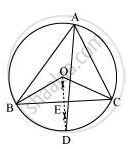
Let perpendicular bisector of side BC and angle bisector of ∠A meet at point D. Let the perpendicular bisector of side BC intersect it at E.
Perpendicular bisector of side BC will pass through circumcentre O of the circle. ∠BOC and ∠BAC are the angles subtended by arc BC at the centre and a point A on the remaining part of the circle respectively. We also know that the angle subtended by an arc at the centre is double the angle subtended by it at any point on the remaining part of the circle.
∠BOC = 2 ∠BAC = 2 ∠A ... (1)
In ΔBOE and ΔCOE,
OE = OE (Common)
OB = OC (Radii of same circle)
∠OEB = ∠OEC (Each 90° as OD ⊥ BC)
∴ ΔBOE ≅ ∠COE (RHS congruence rule)
∠BOE = ∠COE (By CPCT) ... (2)
However, ∠BOE + ∠COE = ∠BOC
⇒ ∠BOE +∠BOE = 2 ∠A [Using equations (1) and (2)]
⇒ 2 ∠BOE = 2 ∠A
⇒ ∠BOE = ∠A
∴ ∠BOE = ∠COE = ∠A
The perpendicular bisector of side BC and angle bisector of ∠A meet at point D.
∴ ∠BOD = ∠BOE = ∠A ... (3)
Since AD is the bisector of angle ∠A,
∠BAD = ∠A/2
⇒ 2 ∠BAD = ∠A ... (4)
From equations (3) and (4), we obtain
∠BOD = 2 ∠BAD
This can be possible only when point BD will be a chord of the circle. For this, the point D lies on the circum circle.
Therefore, the perpendicular bisector of side BC and the angle bisector of ∠A meet on the circum circle of triangle ABC.
संबंधित प्रश्न
Prove that the line of centres of two intersecting circles subtends equal angles at the two points of intersection.
ABCD is a parallelogram. The circle through A, B and C intersect CD (produced if necessary) at E. Prove that AE = AD.
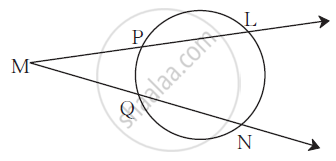
In the figure m(arc LN) = 110°,
m(arc PQ) = 50° then complete the following activity to find ∠LMN.
∠ LMN = `1/2` [m(arc LN) - _______]
∴ ∠ LMN = `1/2` [_________ - 50°]
∴ ∠ LMN = `1/2` × _________
∴ ∠ LMN = __________
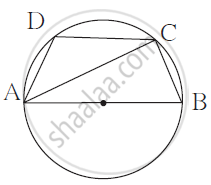
In the figure, `square`ABCD is a cyclic quadrilateral. Seg AB is a diameter. If ∠ ADC = 120˚, complete the following activity to find measure of ∠ BAC.
`square` ABCD is a cyclic quadrilateral.
∴ ∠ ADC + ∠ ABC = 180°
∴ 120˚ + ∠ ABC = 180°
∴ ∠ ABC = ______
But ∠ ACB = ______ .......(angle in semicircle)
In Δ ABC,
∠ BAC + ∠ ACB + ∠ ABC = 180°
∴ ∠BAC + ______ = 180°
∴ ∠ BAC = ______
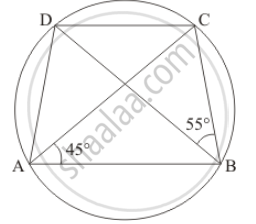
In the given figure, ABCD is a cyclic quadrilateral in which AC and BD are its diagonals. If ∠DBC = 55° and ∠BAC = 45°, find ∠BCD.
Prove that the centre of the circle circumscribing the cyclic rectangle ABCD is the point of intersection of its diagonals.
ABCD is a cyclic quadrilateral such that ∠ADB = 30° and ∠DCA = 80°, then ∠DAB =
In a cyclic quadrilaterals ABCD, ∠A = 4x, ∠C = 2x the value of x is
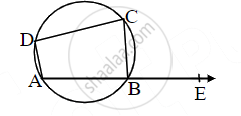
In the figure, ▢ABCD is a cyclic quadrilateral. If m(arc ABC) = 230°, then find ∠ABC, ∠CDA, ∠CBE.
The three angles of a quadrilateral are 100°, 60°, 70°. Find the fourth angle.
