Advertisements
Advertisements
प्रश्न
In an isosceles triangle PQR, the length of equal sides PQ and PR is 13 cm and base QR is 10 cm. Find the length of perpendicular bisector drawn from vertex P to side QR.
Advertisements
उत्तर

Given: In an isosceles triangle PQR, PQ = PR = 13 cm and base QR = 10 cm.
Since, PS is the perpendicular bisector,
∴ QS = SR = `(QR)/2 = 10/2` = 5
Now, using Pythagoras' theorem, in a right-angled triangle PSQ,
PS2 + SQ2 = PQ2
Substituting the values of SQ and PQ in equation (i),
PS2 + 52 = 132
⇒ PS2 = 132 – 52
⇒ PS2 = 169 – 25
⇒ PS2 = 144
∴ PS = `sqrt(144)` = 12
As a result, the length of the perpendicular bisector PS is 12 cm.
APPEARS IN
संबंधित प्रश्न
PQR is a triangle right angled at P. If PQ = 10 cm and PR = 24 cm, find QR.
Which of the following can be the sides of a right triangle?
1.5 cm, 2 cm, 2.5 cm
In the case of right-angled triangles, identify the right angles.
Identify, with reason, if the following is a Pythagorean triplet.
(10, 24, 27)
In the figure: ∠PSQ = 90o, PQ = 10 cm, QS = 6 cm and RQ = 9 cm. Calculate the length of PR.
In triangle ABC, AB = AC and BD is perpendicular to AC.
Prove that: BD2 − CD2 = 2CD × AD
In figure AB = BC and AD is perpendicular to CD.
Prove that: AC2 = 2BC. DC.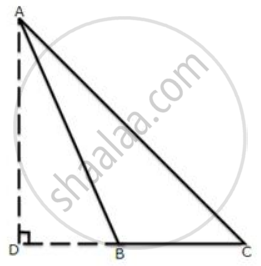
In the following Figure ∠ACB= 90° and CD ⊥ AB, prove that CD2 = BD × AD
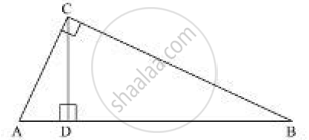
Choose the correct alternative:
In right-angled triangle PQR, if hypotenuse PR = 12 and PQ = 6, then what is the measure of ∠P?
Find the side of the square whose diagonal is `16sqrt(2)` cm.
The sides of a certain triangle is given below. Find, which of them is right-triangle
16 cm, 20 cm, and 12 cm
A man goes 18 m due east and then 24 m due north. Find the distance of his current position from the starting point?
Find the unknown side in the following triangles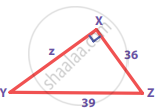
From given figure, In ∆ABC, If AC = 12 cm, then AB = ?
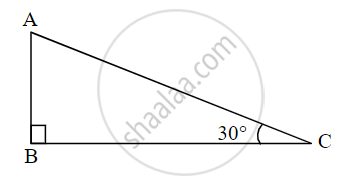
Activity: From given figure, In ∆ABC, ∠ABC = 90°, ∠ACB = 30°
∴ ∠BAC = `square`
∴ ∆ABC is 30° – 60° – 90° triangle.
∴ In ∆ABC by property of 30° – 60° – 90° triangle.
∴ AB = `1/2` AC and `square` = `sqrt(3)/2` AC
∴ `square` = `1/2 xx 12` and BC = `sqrt(3)/2 xx 12`
∴ `square` = 6 and BC = `6sqrt(3)`
In ΔABC, if DE || BC, AD = x, DB = x – 2, AE = x + 2 and EC = x – 1, then value of x is ______.
A 5 m long ladder is placed leaning towards a vertical wall such that it reaches the wall at a point 4 m high. If the foot of the ladder is moved 1.6 m towards the wall, then find the distance by which the top of the ladder would slide upwards on the wall.
Prove that the area of the semicircle drawn on the hypotenuse of a right angled triangle is equal to the sum of the areas of the semicircles drawn on the other two sides of the triangle.
The longest side of a right angled triangle is called its ______.
In a triangle, sum of squares of two sides is equal to the square of the third side.
A right-angled triangle may have all sides equal.
