Advertisements
Advertisements
प्रश्न
If tan x° = `(5)/(12) . tan y° = (3)/(4)` and AB = 48m; find the length CD.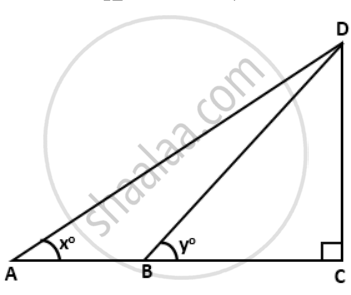
बेरीज
Advertisements
उत्तर
tan x = `"CD"/"AC"`
⇒ `(5)/(12) = "CD"/"AC"`
⇒ 5 x AC = 12 x CD
⇒ 5(AB + BC) = 12CD
⇒ 5(48 + BC) = 12CD
⇒ 48 + BC = `(12"CD")/(5)` ....(i)
tan y = `"CD"/"BC"`
⇒ `(3)/(4) = "CD"/"BC"`
⇒ 3BC = 4CD
⇒ BC = `(6"CD")/(3)` ....(ii)
Substituting (ii) in (i), we have
`48 + (4"CD")/(3) = (12"CD")/(5)`
⇒ `(12"CD")/(5) - (4"CD")/(3)` = 48
⇒ `(36"CD" - 20"CD")/(15)` = 48
⇒ 16CD = 720
⇒ CD = 45m.
shaalaa.com
Trigonometric Equation Problem and Solution
या प्रश्नात किंवा उत्तरात काही त्रुटी आहे का?
