Advertisements
Advertisements
प्रश्न
If a line makes angles α, β, γ, δ with four diagonals of a cube, then cos2 α + cos2 β + cos2γ + cos2 δ is equal to
पर्याय
\[\frac{1}{3}\]
\[\frac{2}{3}\]
\[\frac{4}{3}\]
\[\frac{8}{3}\]
Advertisements
उत्तर
\[\frac{4}{3}\]
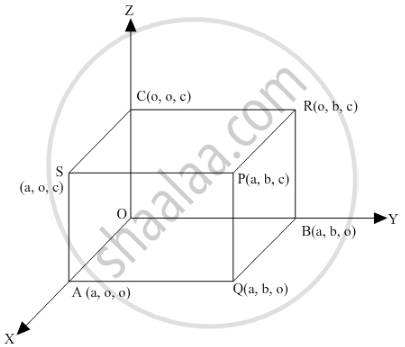
\[\text { Let a be the length of an edge of the cube and let one corner be at the origin as shown in the figure . Clearly, OP, AR, BS and CQ are the diagonals of the cube } . \]
\[\text{ The direction ratios of OP, AR, BS and CQ are } \]
\[a - 0, a - 0, a - 0, \text{ i . e } . a, a, a\]
\[0 - a, a - 0, a - 0, \text{ i . e } . - a, a, a\]
\[a - 0, 0 - a, a - 0,\text{ i . e } . a, - a, a\]
\[a - 0, a - 0, 0 - a\text{ i . e } . a, a, - a \]
\[ \text { Let the direction ratios of a line be proportional to l, m and n . Suppose this line makes angles} \alpha, \beta, \gamma \text { and } \delta \text{ with OP, AR, BS and CQ, respectively i . e } . \]
\[\text{ Now} , \alpha \text{ is the angle between OP and the line whose direction ratios are proportional to l, m and n } . \]
\[ \cos \alpha = \frac{a . l + a . m + a . n}{\sqrt{a^2 + a^2 + a^2}\sqrt{l^2 + m^2 + n^2}} \Rightarrow \cos \alpha = \frac{l + m + n}{\sqrt{3}\sqrt{l^2 + m^2 + n^2}}\]
\[\text{ Since } \beta \text{ is the angle between AR and the line with direction ratios proportional to l, m and n, we get }\]
\[ \cos \beta = \frac{- a . l + a . m + a . n}{\sqrt{a^2 + a^2 + a^2}\sqrt{l^2 + m^2 + n^2}} \Rightarrow \cos \beta = \frac{- l + m + n}{\sqrt{3}\sqrt{l^2 + m^2 + n^2}}\]
\[\text{ Similarly }, \]
\[ \cos \gamma = \frac{a . l - a . m + a . n}{\sqrt{a^2 + a^2 + a^2}\sqrt{l^2 + m^2 + n^2}} \Rightarrow \cos \gamma = \frac{l - m + n}{\sqrt{3}\sqrt{l^2 + m^2 + n^2}}\]
\[ \cos \delta = \frac{a . l + a . m - a . n}{\sqrt{a^2 + a^2 + a^2}\sqrt{l^2 + m^2 + n^2}} \Rightarrow \cos \delta = \frac{l + m - n}{\sqrt{3}\sqrt{l^2 + m^2 + n^2}}\]
\[ \cos^2 \alpha + \cos^2 \beta + \cos^2 \gamma + \cos^2 \delta \]
\[ = \frac{\left( l + m + n \right)^2}{3\left( l^2 + m^2 + n^2 \right)} + \frac{\left( - l + m + n \right)^2}{3\left( l^2 + m^2 + n^2 \right)} + \frac{\left( I - m + n \right)^2}{3\left( l^2 + m^2 + n^2 \right)} + \frac{\left( l + m - n \right)^2}{\sqrt{3}\sqrt{l^2 + m^2 + n^2}}\]
\[ = \frac{1}{3\left( l^2 + m^2 + n^2 \right)}\left\{ \left( l + m + n \right)^2 + \left( - l + m + n \right)^2 + \left( I - m + n \right)^2 + \left( l + m - n \right)^2 \right\}\]
\[ = \frac{1}{3\left( l^2 + m^2 + n^2 \right)}4\left( l^2 + m^2 + n^2 \right) = \frac{4}{3}\]
APPEARS IN
संबंधित प्रश्न
If a line makes angles 90°, 135°, 45° with the X, Y, and Z axes respectively, then its direction cosines are _______.
(A) `0,1/sqrt2,-1/sqrt2`
(B) `0,-1/sqrt2,-1/sqrt2`
(C) `1,1/sqrt2,1/sqrt2`
(D) `0,-1/sqrt2,1/sqrt2`
Find the Direction Cosines of the Sides of the triangle Whose Vertices Are (3, 5, -4), (-1, 1, 2) and (-5, -5, -2).
Find the vector equation of the plane passing through (1, 2, 3) and perpendicular to the plane `vecr.(hati + 2hatj -5hatk) + 9 = 0`
If a line has direction ratios 2, −1, −2, determine its direction cosines.
Show that the points (2, 3, 4), (−1, −2, 1), (5, 8, 7) are collinear.
Find the angle between the lines whose direction ratios are proportional to a, b, c and b − c, c − a, a− b.
If the coordinates of the points A, B, C, D are (1, 2, 3), (4, 5, 7), (−4, 3, −6) and (2, 9, 2), then find the angle between AB and CD.
Find the angle between the lines whose direction cosines are given by the equations
l + 2m + 3n = 0 and 3lm − 4ln + mn = 0
What are the direction cosines of Y-axis?
Write the ratio in which the line segment joining (a, b, c) and (−a, −c, −b) is divided by the xy-plane.
Write the distance of the point P (x, y, z) from XOY plane.
Write the coordinates of the projection of point P (x, y, z) on XOZ-plane.
Find the distance of the point (2, 3, 4) from the x-axis.
If a line has direction ratios proportional to 2, −1, −2, then what are its direction consines?
A parallelopiped is formed by planes drawn through the points (2, 3, 5) and (5, 9, 7), parallel to the coordinate planes. The length of a diagonal of the parallelopiped is
If P (3, 2, −4), Q (5, 4, −6) and R (9, 8, −10) are collinear, then R divides PQ in the ratio
Find the direction cosines of a vector whose direction ratios are
1, 2, 3
Find the direction cosines and direction ratios for the following vector
`5hat"i" - 3hat"j" - 48hat"k"`
A triangle is formed by joining the points (1, 0, 0), (0, 1, 0) and (0, 0, 1). Find the direction cosines of the medians
If a line makes an angle of 30°, 60°, 90° with the positive direction of x, y, z-axes, respectively, then find its direction cosines.
The x-coordinate of a point on the line joining the points Q(2, 2, 1) and R(5, 1, –2) is 4. Find its z-coordinate.
P is a point on the line segment joining the points (3, 2, –1) and (6, 2, –2). If x co-ordinate of P is 5, then its y co-ordinate is ______.
If a line makes an angle of `pi/4` with each of y and z-axis, then the angle which it makes with x-axis is ______.
Find the equations of the two lines through the origin which intersect the line `(x - 3)/2 = (y - 3)/1 = z/1` at angles of `pi/3` each.
If a variable line in two adjacent positions has direction cosines l, m, n and l + δl, m + δm, n + δn, show that the small angle δθ between the two positions is given by δθ2 = δl2 + δm2 + δn2
If the directions cosines of a line are k,k,k, then ______.
The direction cosines of vector `(2hat"i" + 2hat"j" - hat"k")` are ______.
If a line makes angles 90°, 135°, 45° with x, y and z-axis respectively then which of the following will be its direction cosine.
Find the direction cosine of a line which makes equal angle with coordinate axes.
If a line has the direction ratio – 18, 12, – 4, then what are its direction cosine.
What will be the value of 'P' so that the lines `(1 - x)/3 = (7y - 14)/(2P) = (z - 3)/2` and `(7 - 7x)/(3P) = (y - 5)/1 = (6 - z)/5` at right angles.
A line passes through the points (6, –7, –1) and (2, –3, 1). The direction cosines of the line so directed that the angle made by it with positive direction of x-axis is acute, are ______.
A line in the 3-dimensional space makes an angle θ `(0 < θ ≤ π/2)` with both the x and y axes. Then the set of all values of θ is the interval ______.
Equation of line passing through origin and making 30°, 60° and 90° with x, y, z axes respectively, is ______.
Find the coordinates of the foot of the perpendicular drawn from point (5, 7, 3) to the line `(x - 15)/3 = (y - 29)/8 = (z - 5)/-5`.
Which identity must be satisfied by the direction cosines \[(l,m,n)\] of a line?
Any three numbers proportional to the direction cosines of a line are called its:
