Advertisements
Advertisements
प्रश्न
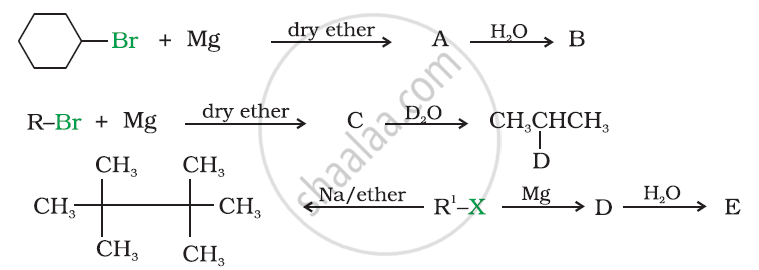
Identify A, B, C, D, E, R and R1 in the following:
Advertisements
उत्तर

Since D of D2O gets attached to the carbon atom to which MgBr is attached, C is:
\[\begin{array}{cc}
\ce{CH3CHCH3}\\
|\phantom{..}\\
\phantom{...}\ce{\underset{Isopropyl Magnesium bromide}{MgBr}}\\
\end{array}\]
Therefore, the compound R−Br is:
\[\begin{array}{cc}
\ce{CH3CHCH3}\\
|\phantom{..}\\
\ce{\underset{2-Bromopropane}{Br}}\
\end{array}\]
\[\begin{array}{cc}
\ce{CH3CHCH3 + Mg ->[dry ether] CH3CHCH3 ->[D2O] CH3CHCH3}\\
\phantom{........}|\phantom{..................}|\phantom{...........................}|\\
\phantom{..........}\ce{Br}\phantom{...............}\ce{\underset{(C)}{MgBr}\phantom{....................}\ce{D}}\phantom{..}\\
\end{array}\]
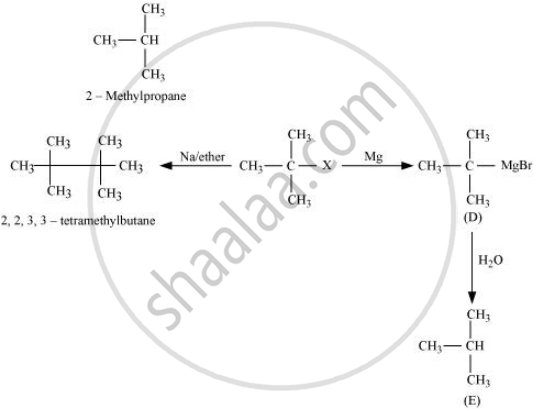
When an alkyl halide is treated with Na in the presence of ether, a hydrocarbon containing double the number of carbon atoms present in the original halide is obtained as a product. This is known as the Wurtz reaction. Therefore, the halide, R1−X, is:
\[\begin{array}{cc}
\phantom{.....}\ce{CH3}\\
\phantom{...}|\\
\ce{CH3 - C - X}\\
\phantom{...}|\\
\phantom{......}\ce{\underset{tert-Butylhalide}{CH3}}\
\end{array}\]
Compound D is:
\[\begin{array}{cc}
\phantom{.}\ce{CH3}\\
|\phantom{..}\\
\ce{CH3 - C - MgBr}\\
|\phantom{..}\\
\phantom{.}\ce{\underset{tert-Butylmagnesiumbromide}{CH3}}\\
\end{array}\]
Compound E is:
APPEARS IN
संबंधित प्रश्न
Explain why Grignard reagents should be prepared under anhydrous conditions?
Write the structure of the major organic product in the following reaction:
\[\ce{C6H5ONa + C2H5Cl ->}\]
What happens when bromobenzene is treated with Mg in the presence of dry ether?
How the following conversion can be carried out?
Chloroethane to butane
Write the structure of main compounds A and B in the following reaction: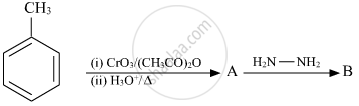
Which one of the following produces acyl halide by treatment with PCl5?
Which of the following statements are correct about the reaction intermediate?

(i) Intermediate (c) is unstable because in this carbon is attached to 5 atoms.
(ii) Intermediate (c) is unstable because carbon atom is sp2 hybridised.
(iii) Intermediate (c) is stable because carbon atom is sp2 hybridised.
(iv) Intermediate (c) is less stable than the reactant (b).
Draw other resonance structures related to the following structure and find out whether the functional group present in the molecule is ortho, para directing or meta directing.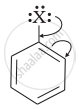
Why is it necessary to avoid even traces of moisture during the use of a Grignard reagent?
Identify the following named reaction:
\[\ce{C2H5Br ->[Na/Dry ether] C2H5 - C2H5}\]
Reaction of Grignard reagent with aromatic aldehyde and subsequent aqueous treatment produces
\[\ce{R - CH2 - CCl2 - R ->[Peagent] R - C ≅ C - R}\]. The reagent is:-
Explain why Grignard reagents should be prepared under anhydrous conditions.
Explain why Grignard reagents should be prepared under anhydrous conditions?
Explain why Grignard reagents should be prepared under anhydrous conditions?
Explain why Grignard reagents should be prepared under anhydrous conditions?
Explain why Grignard reagents should be prepared under anhydrous conditions?
