Advertisements
Advertisements
प्रश्न
How are we able to see nearby and also the distant objects clearly?
Advertisements
उत्तर
Eyes have the ability to adjust its focal length which is known as the power of accommodation and we can see nearby and also the distant objects clearly. Relaxation of muscles makes the lens thinner and its focal length increases to make us see the distant objects clearly. The contraction of ciliary muscles increases the curvature of the eye lens and makes the eye lens thicker. Consequently, the focal length of the eye lens decreases. This enables us to see nearby objects clearly.
APPEARS IN
संबंधित प्रश्न
The least distance of distinct vision for a young adult with normal vision is about ______.
Write the name.
The sensation on the retina persists for a while is
Write the name.
The persons which are unable to distinguish between different colours
Write an Explanation.
Persistence of vision
The eyes of the nocturnal birds like owls are having a large cornea and a large pupil. How does it help them?
Having two eyes facilitates in
A: Increasing the field of view
B: Bringing three-dimensional view
C: Developing the concept of distance/size
Then the correct option is/are
Near and far points of a young person normal eye respectively are:
The ability of the eye lens to adjust its focal length to form a sharp image of the object at varying distances on the retina is called:
The least distance of distinct vision for a normal eye is ____________.
The danger signals installed at the top of tall buildings are red in colour. These can be easily seen from a distance because among all other colours, the red light
When light rays enter the eye, most of the refraction occurs at the
A piece of red glass is heated till its glows in dark. The colour of flowing glass would be:-
In the blind spot of the human eye ______.
In simple microscope ______ lens is used.
Adjusting the focal length of the eye lens to view objects at different distances is done by ______.
Define the following term:
Adaptation
The figures (A) and (B) given below are showing some kind of adjustment. Study the figures and answer the questions that follow.
| A | 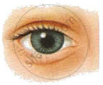 |
 |
B |
- Identify the kinds of adjustments done in the figures (A) and (B).
- Distinguish between the adjustments of figures (A) and (B) on the basis of:
- The size of pupil.
- The pigment which gets regenerated.
- Cells of the retina.
