Advertisements
Advertisements
प्रश्न
Propanal and Propanone
Give a chemical test to distinguish between propanal and propanone.
Give a simple chemical test to distinguish between propanal and propanone.
Advertisements
उत्तर १
Propanal and propanone can be distinguished by the following tests:
- Tollen’s test: Propanal is an aldehyde. Thus, it reduces Tollen’s reagent. But, propanone being a ketone does not reduce Tollen’s reagent.
\[\ce{\underset{Propanal}{CH3CH2CHO} + \underset{Tollen's reagent}{2[Ag(NH3)2]+} + 3OH- -> \underset{Propanoate ion}{CH3CH2COO-} + \underset{Silver mirror}{Ag\downarrow} + NH3 + 2H2O}\] - Fehling’s test: Aldehydes respond to Fehling’s test, but ketones do not. Propanal, being an aldehyde reduces Fehling’s solution to a red-brown precipitate of Cu2O, but propanone being a ketone does not.
\[\ce{\underset{Propanal}{CH3CH2CHO} + 2Cu^2+ + 5OH- -> \underset{Propanoate ion}{CH3CH2COO-} + \underset{(Red-brown ppt)}{\underset{Cuprous oxide}{Cu2O\downarrow}}+ 2H2O}\] - Iodoform test: Aldehydes and ketones with at least one methyl group linked to the carbonyl carbon atom respond to the iodoform test. They are oxidized by sodium hypoiodite (NaOI) to give iodoforms. Propanone being a methyl ketone responds to this test, but propanal does not.
\[\ce{\underset{Propanone}{CH3COCH3} + 3NaOI -> \underset{Sodium acetate}{CH3COONa} + \underset{(yellow ppt)}{\underset{Iodoform}{CHI3}}+ 2NaOH}\]
उत्तर २
| Reagent | Propanal | Propanone |
| Tollen’s Reagent | On heating with Tollen’s reagent, a silver mirror is formed on the inner walls of the test tube. Aldehyde groups reduce the Tollen’s reagent. | On heating in a water bath with Tollen’s reagent does not show any reaction. |
APPEARS IN
संबंधित प्रश्न
Distinguish between:
C6H5-COCH3 and C6H5-CHO
Distinguish between: CH3COOH and HCOOH
A and B are two functional isomers of compound C3H6O.On heating with NaOH and I2, isomer B forms yellow precipitate of iodoform whereas isomer A does not form any precipitate. Write the formulae of A and B.
Give a simple chemical test to distinguish between the following pair of compounds :
CH3CH2CHO and CH3CH2COCH3
Give a simple chemical test to distinguish between the following pair of compounds:
Acetophenone and Benzophenone
Give a simple chemical test to distinguish between the following pair of compounds:
Phenol and Benzoic acid
Give a simple chemical test to distinguish between the following pair of compounds:
Benzoic acid and Ethyl benzoate
Give a simple chemical test to distinguish between the following pair of compounds:
Pentan-2-one and Pentan-3-one
Give a simple chemical test to distinguish between the following pair of compounds:
Benzaldehyde and Acetophenone
An organic compound contains 69.77% carbon, 11.63% hydrogen and rest oxygen. The molecular mass of the compound is 86. It does not reduce Tollens’ reagent but forms an addition compound with sodium hydrogensulphite and give positive iodoform test. On vigorous oxidation it gives ethanoic and propanoic acid. Write the possible structure of the compound.
Solvent used for dewaxing of petroleum products are
Acetone and acetaldehyde are differentiated by
Acetaldehyde cannot show?
Which of the following tests/reactions is given by aldehydes as well as ketones?

Which among the above compound/s does/do not form Silver mirror when treated with Tollen's reagent?
An organic compound neither reacts with neutral ferric chloride solution nor with Fehling solution. It however, reacts with Grignard reagent and gives positive iodoform test. The compound is:
The reagent that can be used to distinguish acetophenone and benzophenone is ______.
Match List-I with List-II:
| List-I (Reaction) |
List-II (Reagents/Condition) |
||
| A. | 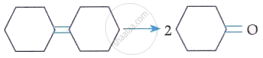 |
I. | 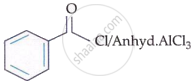 |
| B. | 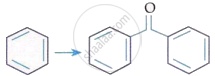 |
II. | CrO3 |
| C. | 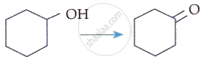 |
III. | KMnO4/KOH, Δ |
| D. | 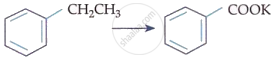 |
IV. | (i) O3 (ii) Zn-H2O |
Choose the correct answer from the options given below:
