मराठी

Find the Vector Equation of the Plane that Contains the Lines → R = ( ˆ I + ˆ J ) + λ ( ˆ I + 2 ˆ J − ˆ K ) and the Point (–1, 3, –4). Also, Find the Length of the Perpendicular Drawn - Mathematics

Advertisements
Advertisements

प्रश्न

Find the vector equation of the plane that contains the lines `vecr = (hat"i" + hat"j") + λ (hat"i" + 2hat"j" - hat"k")` and the point (–1, 3, –4). Also, find the length of the perpendicular drawn from the point (2, 1, 4) to the plane thus obtained.

बेरीज
Advertisements

उत्तर

Let the vector equation of the required plane be  `vec"r" . vec"n" = d`
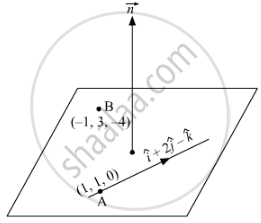
The plane contains the line `vec"r" = hat"i" + hat"j" + λ (hat"i" + 2hat"j" - hat"k")`

Since the plane passes through point A and B. So `vec"n"` will be parallel to vector `vec"AB" xx (hat"i" + 2hat"j" - hat"k")`

`vec"AB" = vec"OB" -vec"OA"`

= `(-hat"i" + 3hat"j" - 4hat"k") (hat"i" + hat"j")`

= `-2hat"i" + 2hat"j" - 4hat"k"`

`vec"AB" xx (hat"i" + 2hat"j" - hat"k") = |(hat"i",hat"j",hat"k"),(1,2,-1),(-2,2, -4)|`

= `hat"i" (-8 + 2) - hat"j" (-4-2) + hat"k" (2+4)`

= `-6hat"i" + 6hat"j" + 6hat"k"`

which is a normal vector to the plane.

So the equation of plane will be `vec"r" . (-6hat"i" + 6hat"j" + 6hat"k") = d`

∴ it passes through (1, 1, 0) so `(hat"i" + hat"j"). (-6hat"i" + 6hat"j" + 6hat"k") = d or, d = 0`

equation of plane is `vecr . (-6hat"i" + 6hat"j" + 6hat"k") = 0`

`vecr (hat"i" - hat"j" -hat"k") = 0`

in Cartesian plane,

`(xhat"i" + yhat"j" + zhat"k") . (hat"i" - hat"j" -hat"k") = 0`

x -y - z = 0

So, the perpendicular distance of the plane from the point (2, 1, 4) is  ` = |(2 -1-4)/sqrt(1^2 + (-1)^2 + (-1)^2)| = |(-3)/sqrt(3)| = sqrt(3) "unit"`.

shaalaa.com
  या प्रश्नात किंवा उत्तरात काही त्रुटी आहे का?
2018-2019 (March) 65/1/3

व्हिडिओ ट्यूटोरियलVIEW ALL [3]

संबंधित प्रश्‍न

Find the vector equation of the plane passing through the points `hati +hatj-2hatk, hati+2hatj+hatk,2hati-hatj+hatk`. Hence find the cartesian equation of the plane.


Parametric form of the equation of the plane is `bar r=(2hati+hatk)+lambdahati+mu(hat i+2hatj+hatk)` λ and μ are parameters. Find normal to the plane and hence equation of the plane in normal form. Write its Cartesian form.


Find the vector equation of the plane which contains the line of intersection of the planes `vecr (hati+2hatj+3hatk)-4=0` and `vec r (2hati+hatj-hatk)+5=0` which is perpendicular to the plane.`vecr(5hati+3hatj-6hatk)+8=0`


Find the vector equation of the plane with intercepts 3, –4 and 2 on x, y and z-axis respectively.


Find the equation of the plane which contains the line of intersection of the planes

`vecr.(hati-2hatj+3hatk)-4=0" and"`

`vecr.(-2hati+hatj+hatk)+5=0`

and whose intercept on x-axis is equal to that of on y-axis.


Find the vector equation of a plane which is at a distance of 5 units from the origin and its normal vector is `2hati-3hatj+6hatk`


The x-coordinate of a point of the line joining the points P(2,2,1) and Q(5,1,-2) is 4. Find its z-coordinate


Find the Cartesian equation of the following planes:

`vecr.(hati + hatj-hatk) = 2`


Find the Cartesian equation of the following planes:

`vecr.(2hati + 3hatj-4hatk) = 1`


In the following cases, find the coordinates of the foot of the perpendicular drawn from the origin.

3y + 4z – 6 = 0


In the following cases, find the coordinates of the foot of the perpendicular drawn from the origin.

x + y + z = 1


In the following cases, find the coordinates of the foot of the perpendicular drawn from the origin.

5y + 8 = 0


Find the vector and Cartesian equation of the planes that passes through the point (1, 0, −2) and the normal to the plane is `hati + hatj - hatk`


Find the vector and Cartesian equation of the planes that passes through the point (1, 4, 6) and the normal vector to the plane is `hati -2hatj +  hatk`


Find the cartesian form of the equation of the plane `bar r=(hati+hatj)+s(hati-hatj+2hatk)+t(hati+2hatj+hatj)`


Find the vector and Cartesian forms of the equation of the plane passing through the point (1, 2, −4) and parallel to the lines \[\vec{r} = \left( \hat{i} + 2 \hat{j}  - 4 \hat{k}  \right) + \lambda\left( 2 \hat{i}  + 3 \hat{j}  + 6 \hat{k}  \right)\] and \[\vec{r} = \left( \hat{i}  - 3 \hat{j}  + 5 \hat{k}  \right) + \mu\left( \hat{i}  + \hat{j}  - \hat{k} \right)\] Also, find the distance of the point (9, −8, −10) from the plane thus obtained.  


Find the vector equation of the line passing through (1, 2, 3) and parallel to the planes  \[\vec{r} \cdot \left( \hat{i}  - \hat{j}  + 2 \hat{k}  \right) = 5 \text{ and } \vec{r} \cdot \left( 3 \hat{i}  + \hat{j}  + \hat{k}  \right) = 6 .\]


Vector equation of a line which passes through a point (3, 4, 5) and parallels to the vector `2hati + 2hatj - 3hatk`.


The vector equation of the line `(x - 5)/3 = (y + 4)/7 = (z - 6)/2` is ______.


The Cartesian equation of the plane `vec"r" * (hat"i" + hat"j" - hat"k")` = 2 is ______.


Share
Notifications

Englishहिंदीमराठी


      Forgot password?
Use app×