Advertisements
Advertisements
प्रश्न
Find the coordinates of the image of the point (1, 6, 3) with respect to the line `vecr = (hatj + 2hatk) + λ(hati + 2hatj + 3hatk)`; where 'λ' is a scalar. Also, find the distance of the image from the y – axis.
Advertisements
उत्तर
Let P(1, 6, 3) be the given point, and let 'L' be the foot of the perpendicular from 'P' to the given line AB (as shown in the figure below). The coordinates of a general point on the given line are given by
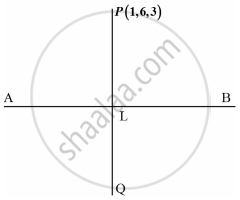
`(x - 0)/1 = (y - 1)/2 = (z - 2)/3` = λ; λ is a scalar, i.e., x = λ, y = 2λ + 1 and z = 3λ + 2
Let the coordinates of L be (λ, 2λ + 1, 3λ + 2).
So, direction ratios of PL are λ – 1, 2λ + 1 – 6 and 3λ + 2 – 3, i.e., λ – 1, 2λ – 5 and 3λ – 1.
Direction ratios of the given line are 1, 2 and 3, which is perpendicular to PL.
Therefore, (λ – 1)1 + (2λ – 5)2 + (3λ – 1)3 = 0
`\implies` 14λ – 14 = 0
`\implies` λ = 1
So, coordinates of L are (1, 3, 5).
Let Q(x1, y1, z1) be the image of P(1, 6, 3) in the given line.
Then, L is the mid-point of PQ.
Therefore, `((x_1 + 1))/2` = 1, `((y_1 + 6))/2` = 3 and `((z_1 + 3))/2` = 5
`\implies` x1 = 1, y1 = 0 and z1 = 7
Hence, the image of P(1, 6, 3) in the given line is (1, 0, 7).
Now, the distance of the point (1, 0, 7) from the y-axis is `sqrt(1^2 + 7^2) = sqrt(50)` units.
APPEARS IN
संबंधित प्रश्न
Which of the following represents direction cosines of the line :
(a)`0,1/sqrt2,1/2`
(b)`0,-sqrt3/2,1/sqrt2`
(c)`0,sqrt3/2,1/2`
(d)`1/2,1/2,1/2`
Write the direction ratios of the following line :
`x = −3, (y−4)/3 =( 2 −z)/1`
If a line makes angles of 90°, 60° and 30° with the positive direction of x, y, and z-axis respectively, find its direction cosines
Using direction ratios show that the points A (2, 3, −4), B (1, −2, 3) and C (3, 8, −11) are collinear.
Find the angle between the vectors with direction ratios proportional to 1, −2, 1 and 4, 3, 2.
Show that the points (2, 3, 4), (−1, −2, 1), (5, 8, 7) are collinear.
Show that the line joining the origin to the point (2, 1, 1) is perpendicular to the line determined by the points (3, 5, −1) and (4, 3, −1).
A line makes an angle of 60° with each of X-axis and Y-axis. Find the acute angle made by the line with Z-axis.
Find the distance of the point (2, 3, 4) from the x-axis.
For every point P (x, y, z) on the xy-plane,
Ratio in which the xy-plane divides the join of (1, 2, 3) and (4, 2, 1) is
The direction ratios of the line which is perpendicular to the lines with direction ratios –1, 2, 2 and 0, 2, 1 are _______.
Verify whether the following ratios are direction cosines of some vector or not
`1/sqrt(2), 1/2, 1/2`
Verify whether the following ratios are direction cosines of some vector or not
`4/3, 0, 3/4`
Find the direction cosines and direction ratios for the following vector
`5hat"i" - 3hat"j" - 48hat"k"`
If `1/2, 1/sqrt(2), "a"` are the direction cosines of some vector, then find a
If the direction ratios of a line are 1, 1, 2, find the direction cosines of the line.
Find the direction cosines of the line passing through the points P(2, 3, 5) and Q(–1, 2, 4).
The x-coordinate of a point on the line joining the points Q(2, 2, 1) and R(5, 1, –2) is 4. Find its z-coordinate.
If a line makes an angle of `pi/4` with each of y and z-axis, then the angle which it makes with x-axis is ______.
What will be the value of 'P' so that the lines `(1 - x)/3 = (7y - 14)/(2P) = (z - 3)/2` and `(7 - 7x)/(3P) = (y - 5)/1 = (6 - z)/5` at right angles.
The co-ordinates of the point where the line joining the points (2, –3, 1), (3, –4, –5) cuts the plane 2x + y + z = 7 are ______.
The projections of a vector on the three coordinate axis are 6, –3, 2 respectively. The direction cosines of the vector are ______.
If the equation of a line is x = ay + b, z = cy + d, then find the direction ratios of the line and a point on the line.
For direction ratios \[(a,b,c)\], which set can represent the corresponding direction cosines when the direction of the line is chosen?
